

Children and Antihistamines: Safe Dosing by Age and What Parents Need to Know
 Dec, 26 2025
Child Antihistamine Dosing Calculator
Calculate Safe Antihistamine Dose
Results
Enter your child's weight and age to see safe antihistamine dosing.
When your child breaks out in hives after eating peanuts, or their nose won’t stop running during pollen season, it’s natural to reach for an antihistamine. But not all antihistamines are safe for kids-and giving the wrong one, or the wrong dose, can be dangerous. Many parents still use Benadryl because it’s familiar, cheap, and seems to work fast. But what works for adults doesn’t always work for children, especially under age 2. The truth is, antihistamines for kids need careful handling, precise dosing, and a clear understanding of which ones are actually safe.
First-Generation vs. Second-Generation: Why It Matters
Not all antihistamines are created equal. There are two main types: first-generation and second-generation. The difference isn’t just about brand names-it’s about how they affect your child’s brain and body. First-generation antihistamines like diphenhydramine (Benadryl) cross the blood-brain barrier easily. That’s why they make adults sleepy. In young children, that same effect can turn into something more serious: extreme drowsiness, confusion, rapid heartbeat, dry mouth, or even seizures. Studies show that up to 60% of kids given diphenhydramine become drowsy. That’s not just a side effect-it’s a safety risk. Second-generation antihistamines like cetirizine (Zyrtec) and loratadine (Claritin) are designed to stay out of the brain. They’re less likely to cause drowsiness-only about 10-15% of kids feel sleepy on cetirizine, and even fewer on loratadine. They also last longer, so you only need to give them once a day. That reduces the chance of dosing errors. The American Academy of Allergy, Asthma & Immunology and major children’s hospitals like Boston Children’s and Children’s Hospital Colorado now recommend second-generation antihistamines as the first choice for kids with allergies. Diphenhydramine is no longer considered a routine treatment for children under 6. It’s reserved for emergencies, like sudden hives or anaphylaxis, and even then, only under a doctor’s direction.Age-Appropriate Dosing: Exact Numbers, Not Guesswork
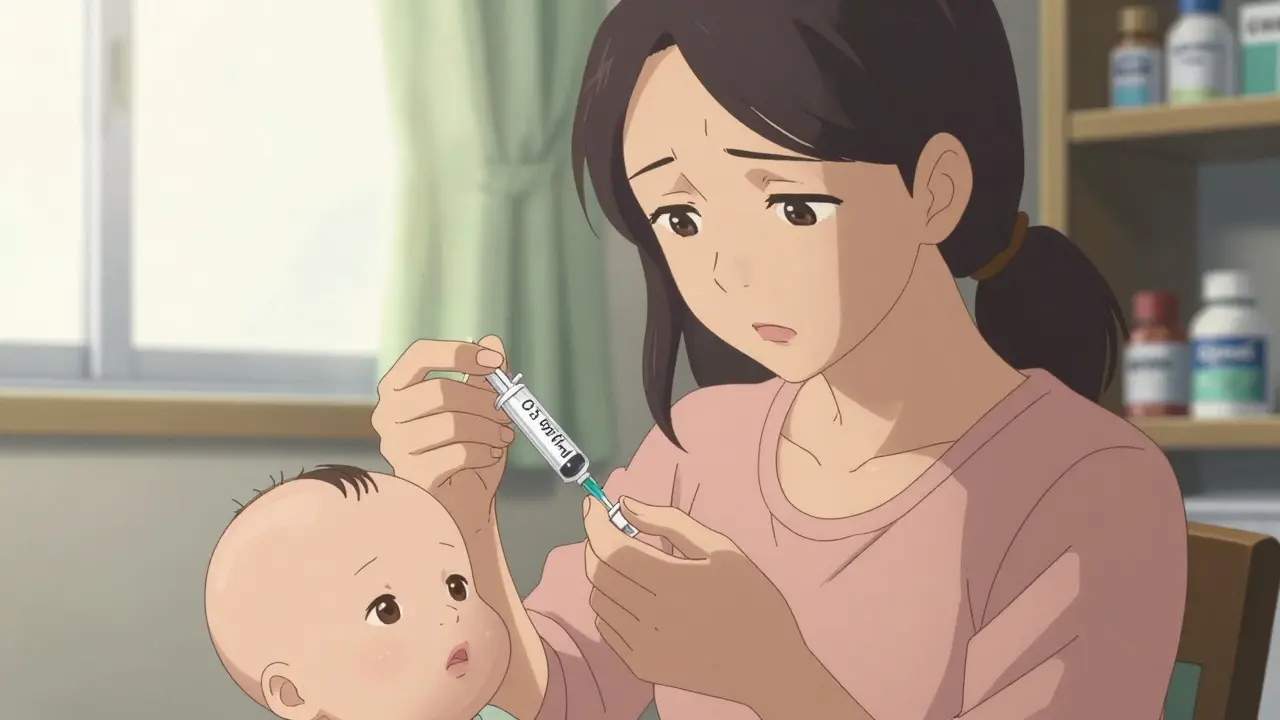
Dosing isn’t about “a little bit for toddlers” or “half an adult pill.” It’s based on weight and age-and using a kitchen spoon can lead to dangerous mistakes. For infants 6 to 11 months: Cetirizine is approved for this age group. The standard dose is 0.25 mg per kilogram of body weight per day. For an 8 kg (17.6 lb) baby, that’s about 2 mg total per day. Some doctors start lower-at 0.125 mg/kg-to be extra cautious. That’s roughly 1 mg per day for an 8 kg infant. Always use the liquid form with the provided syringe. Never guess. For children 2 to 5 years: Cetirizine: 5 mg once daily (1 teaspoon of liquid). Loratadine: 5 mg once daily (also 1 teaspoon of liquid). Both come in 5 mg per 5 mL bottles. Make sure you’re using the measuring device that came with the bottle. A regular teaspoon can hold anywhere from 3 mL to 7 mL-too much or too little can cause problems. For children 6 to 11 years: Cetirizine: 5 to 10 mg daily. Loratadine: 10 mg daily. Some kids need the higher dose for persistent symptoms. If using chewables, check the label. Some children’s chewables are 5 mg, others are 10 mg. Confusing them can lead to double dosing. For children 12 years and older: Same as adults: 10 mg cetirizine or loratadine once daily. Diphenhydramine is not recommended for routine use in children under 6. If used at all for acute reactions, dosing is strictly weight-based: 12.5 mg every 4 to 6 hours for kids weighing 38-49 lbs (about 17-22 kg). That’s 7.5 mL of liquid (12.5 mg/5 mL) or 1.5 chewable tablets. Never give more than 6 doses in 24 hours.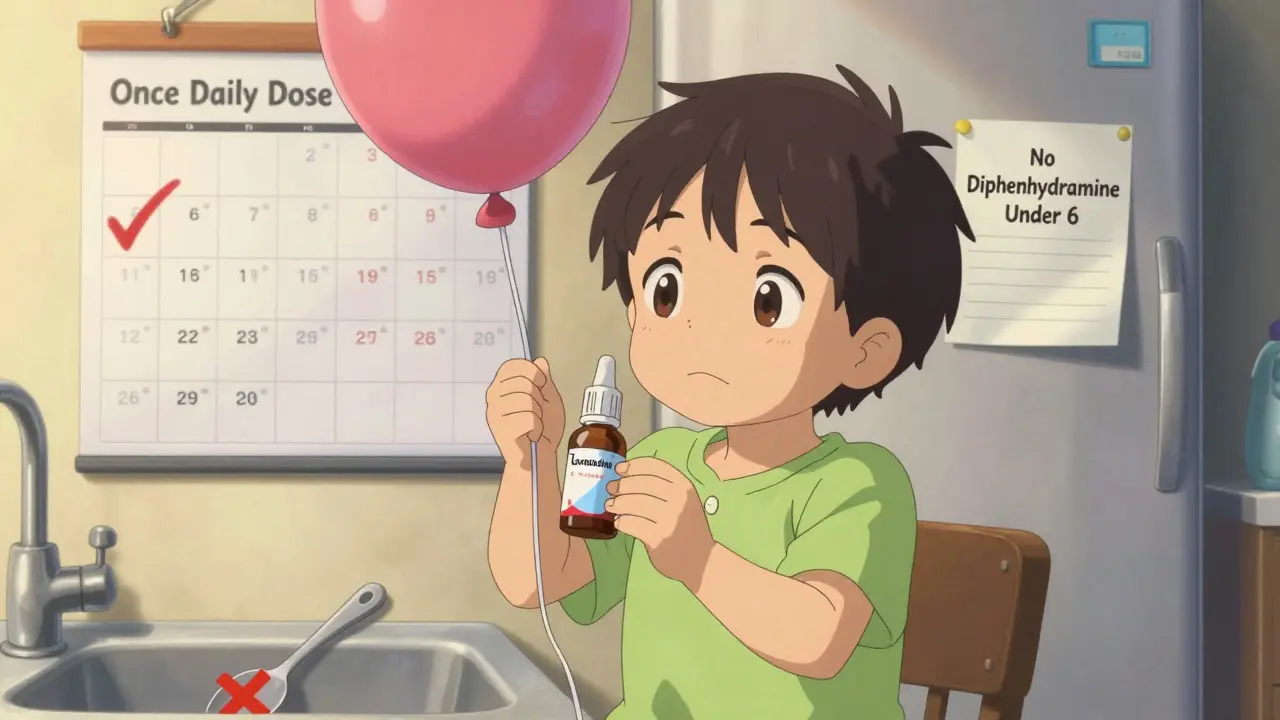
What to Avoid: Common Mistakes That Put Kids at Risk
Parents mean well. But simple errors can have serious consequences. Mistake 1: Using adult antihistamines. A 10 mg tablet of loratadine is not a “small” dose for a 3-year-old. That’s double what they need. Cutting pills is unreliable and risky. Always use pediatric formulations. Mistake 2: Using combination products. Many cold and allergy medicines combine antihistamines with decongestants like pseudoephedrine or phenylephrine. These are not approved for children under 6. The FDA and AAP warn against them. Even if the label says “children’s,” if it has “plus decongestant” or “multi-symptom,” don’t give it to a child under 6. Mistake 3: Using antihistamines as sleep aids. This is one of the most dangerous habits. Giving Benadryl to help a child sleep increases overdose risk by 300% in children under 2, according to the American College of Allergy, Asthma, and Immunology. The sedation isn’t harmless-it’s a sign the drug is affecting the central nervous system. And it doesn’t improve sleep quality-it just masks symptoms. Mistake 4: Using kitchen spoons. A study from Boston Children’s Hospital found that 45% of parents using kitchen teaspoons gave the wrong dose-some by as much as 50%. Always use the syringe, dropper, or cup that came with the medicine. If you lose it, call your pharmacy for a replacement. They’ll give you one for free.When to Call the Doctor or Poison Control
Antihistamines are generally safe when used correctly. But red flags should never be ignored. Call your pediatrician if:- Your child has hives or swelling that doesn’t improve after 24 hours of antihistamine use
- Your child is under 2 years old and you’re considering any antihistamine
- Your child has trouble breathing, wheezing, or swelling of the lips or tongue (go to the ER immediately-this could be anaphylaxis)
- Extreme drowsiness or can’t be woken up
- Racing heart or irregular heartbeat
- Confusion, hallucinations, or seizures
- Very dry mouth, flushed skin, or difficulty urinating
- Agitation or unusual behavior
What’s Changing in 2025 and What’s Coming
The rules around antihistamines for kids are evolving. In 2023, the FDA required new safety studies for all antihistamines used in children under 2. Results are expected by 2025. Meanwhile, ongoing clinical trials (NCT04567821) are testing whether cetirizine can be safely approved for infants under 6 months. Right now, that’s off-label use-and only done under specialist supervision, starting at 0.125 mg/kg/day. Pediatric allergists are moving away from first-generation drugs fast. A 2023 survey by the AAAAI found that 94.7% of specialists now use second-generation antihistamines as first-line treatment for children. The biggest barrier? Parents and even some primary care providers still default to Benadryl because it’s been around for decades. Hospitals like Boston Children’s and Children’s Hospital Colorado have updated their internal guidelines to reflect this shift. They now train staff to ask: “Is this child under 2? Are we sure we need an antihistamine? Which one, and why?”What Parents Should Do Today
You don’t need to be a pharmacist to keep your child safe. Here’s what to do right now:- Throw out any old bottles of Benadryl labeled for kids under 2. They’re not safe for routine use.
- Keep only one antihistamine on hand: cetirizine (Zyrtec) or loratadine (Claritin) in liquid form.
- Always use the measuring device that came with the bottle. No exceptions.
- Write down your child’s weight and keep it next to the medicine cabinet. Dosing is weight-based, not age-based.
- Never use antihistamines to make your child sleepy. If they’re having trouble sleeping, talk to your doctor.
- When in doubt, call your pediatrician or poison control. It’s better to be safe than sorry.
SHAKTI BHARDWAJ
December 27, 2025 AT 21:26OMG I JUST GAVE MY 18MO OLD BENADRYL BECAUSE SHE CRIED ALL NIGHT AND I THOUGHT SHE WAS ALLERGIC TO HER PJS LMAO NOW SHE SLEEPING LIKE A LOG BUT I FEEL LIKE A TERRIBLE MOM 😭
Matthew Ingersoll
December 27, 2025 AT 22:01This is one of the most important public health messages about pediatric medication I’ve read in years. The shift away from first-gen antihistamines is long overdue. Parents need to stop treating Benadryl like candy.
jesse chen
December 29, 2025 AT 18:02I can't believe how many parents still use kitchen spoons... I've seen it myself. One mom told me she 'just eyeballed it' because the syringe got lost. That's not negligence-it's a ticking time bomb. Always use the device that comes with the bottle. Always.
Alex Ragen
December 31, 2025 AT 07:35It’s ironic, isn’t it? We live in an age of algorithmic precision, yet we still trust our instincts over pharmacology when it comes to our children’s health. The antihistamine crisis isn’t about ignorance-it’s about the romanticization of old remedies as ‘natural’ or ‘trusted.’ But Benadryl isn’t Grandma’s remedy-it’s a CNS depressant with a 60% sedation rate in toddlers. We’re not parenting; we’re performing nostalgia.
Lori Anne Franklin
December 31, 2025 AT 12:43Yessss this is so needed!! I just got my 3yo’s Zyrtec prescription and the pharmacist gave me a new syringe for free!! So nice of them!! I used to just wing it with a regular spoon ugh
Sarah Holmes
January 2, 2026 AT 01:55Let’s be clear: The American Academy of Pediatrics has been warning about this for a decade. The fact that parents are still using Benadryl as a sleep aid is not a failure of education-it’s a failure of moral responsibility. You are not helping your child by drugging them into silence. You are suppressing symptoms with a neurotoxin. Shame on those who continue this practice.
Jay Ara
January 3, 2026 AT 23:11my son got hives last year and i used zyrtec liquid with the syringe like u said... he was fine in 20 min. no sleepiness no drama. just calm. thank u for this post
Michael Bond
January 5, 2026 AT 20:38Second-gen only. Done.
Kuldipsinh Rathod
January 6, 2026 AT 14:16my cousin in delhi gave her 1yr old benadryl for a rash and she got super hyper and vomited for hours. i told her to stop but she said 'it worked before'... this post is so real
carissa projo
January 7, 2026 AT 06:09There’s something deeply tender about how we try to fix everything for our kids-with medicine, with silence, with sleep. But sometimes, the most loving thing isn’t to make them quiet… it’s to listen to what their bodies are screaming. Antihistamines aren’t bandaids for exhaustion. They’re tools. And tools need respect, not desperation. Let’s treat our children like they’re worth more than a sedated pause.
josue robert figueroa salazar
January 8, 2026 AT 21:24Benadryl is a gateway drug to pediatric ER visits. End of story.
david jackson
January 10, 2026 AT 04:12Let me tell you about the time I gave my 4-year-old Claritin because I thought he had a cold... but he had a mild allergic reaction to his new dog. I didn’t know the difference. I thought ‘allergies = sniffles’. Turns out, he was breaking out in hives under his shirt. The pediatrician said if I’d waited another 6 hours, it could’ve escalated. That’s when I realized: I didn’t know anything. I just Googled ‘kids allergy medicine’ and picked the cheapest one. I’m so grateful for posts like this. I wish I’d read this two years ago.
Jody Kennedy
January 11, 2026 AT 07:20Y’all this is LIFE-SAVING info!! I just threw out my kid’s old Benadryl bottle and ordered Zyrtec today!! You’re not just helping kids-you’re saving families from panic attacks at 3am!! Thank you for writing this!!