

Generic Drug Quality Issues: Manufacturing Plant Problems Explained
 Feb, 28 2026
When you pick up a generic pill at the pharmacy, you expect it to work just like the brand-name version. Same active ingredient. Same dose. Same effect. But what if that pill was made in a factory with dirty floors, missing records, or workers throwing out test results? This isn’t fiction. It’s happening right now - and it’s putting lives at risk.
Why Generic Drugs Fail
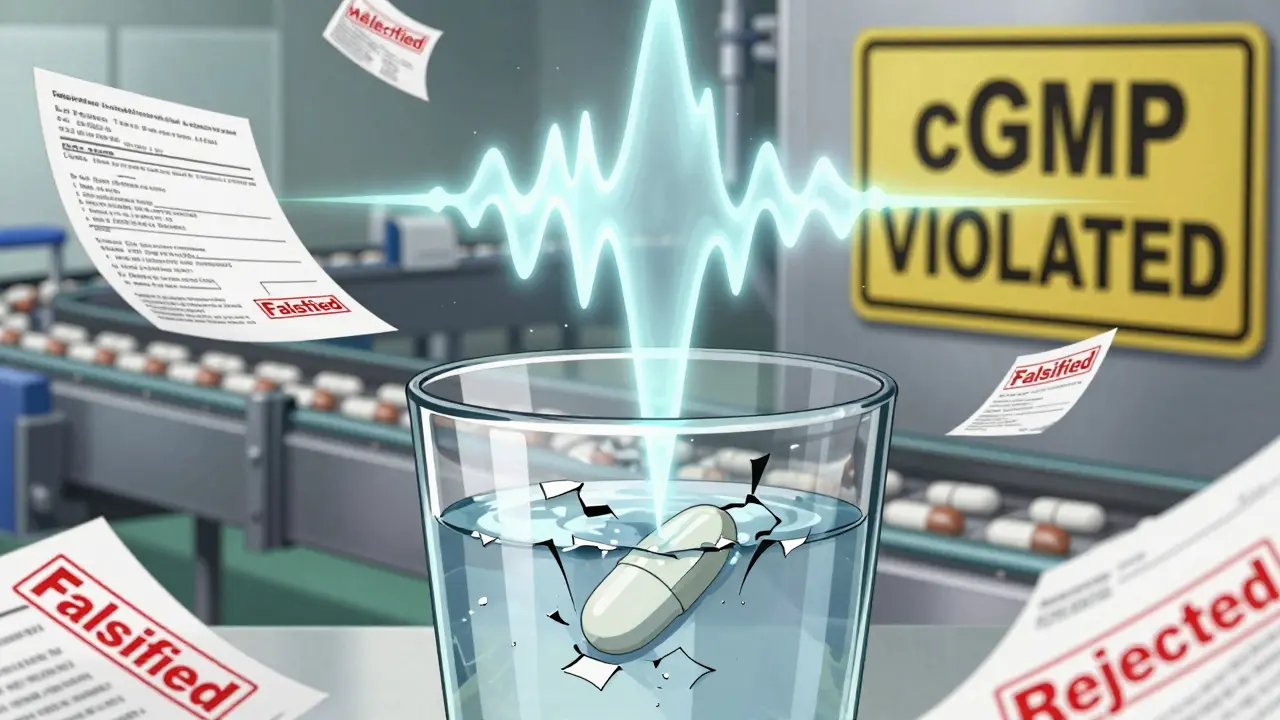
Generic drugs are supposed to be cheaper copies of brand-name medications. They’re not supposed to be worse. But when manufacturing goes wrong, they can be. The core problem? Current Good Manufacturing Practices (cGMP) aren’t being followed. These are the rules that say how drugs must be made, tested, and documented. Break them, and you risk contamination, inconsistent dosing, or even deadly impurities.In 2018, the FDA found N-nitrosodimethylamine (NDMA) - a known carcinogen - in blood pressure pills made by a Chinese company. That single discovery triggered 28 recalls across 22 countries. Nearly 2.1 million patients were affected. NDMA wasn’t supposed to be there. It formed because of a poorly designed chemical process. No one caught it because quality checks were skipped or falsified.
It’s not just NDMA. Other issues include:
- Wrong particle size in inhalers, leading to under-dosing
- Unstable packaging that lets moisture in, breaking down the drug
- Outdated lab methods that miss impurities
- Raw materials from unapproved suppliers
These aren’t random mistakes. They’re systemic failures tied to how factories operate - especially overseas.
The Global Supply Chain Problem
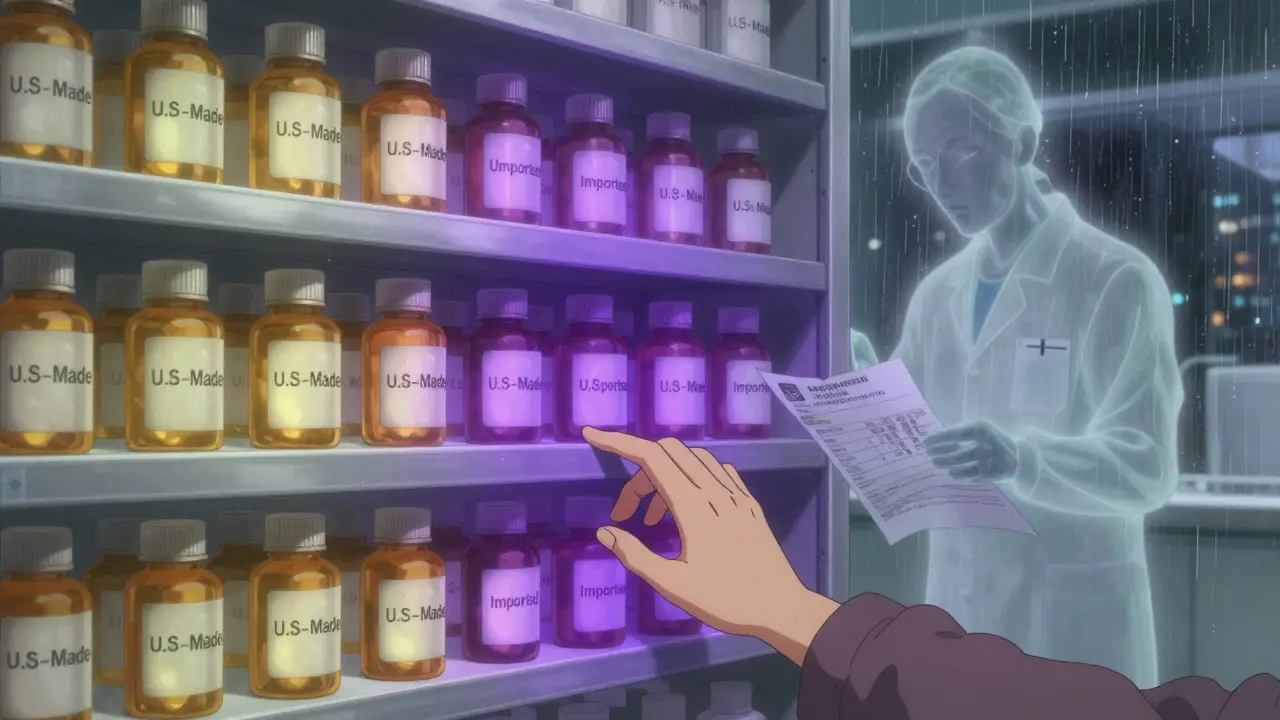
Eighty percent of the active ingredients in your pills come from just two countries: China and India. Forty percent of finished pills - the ones in the bottle - are made there too. That’s not a coincidence. It’s cost-driven. Labor is cheaper. Regulations are looser. And the FDA, despite having authority over every pill sold in the U.S., can’t inspect every factory.In 2016, the Government Accountability Office found that nearly 1,000 foreign facilities exporting drugs to the U.S. had never been inspected. Even today, the FDA inspects only about 13% of foreign facilities each year. Meanwhile, 73% of all finished drug products are made abroad.
Here’s the kicker: U.S. facilities get unannounced inspections. Foreign ones? They get warned weeks in advance. That gives factories time to clean up, hide documents, or even temporarily hire extra staff just for the inspection. A 2023 study from Ohio State University found that generic drugs made in India caused 23.7% more severe side effects than those made in the U.S.
It gets worse. Only 0.02% of imported drug shipments are tested in a lab. That’s one out of every 5,000 bottles. The rest? Approved based on paperwork - paperwork that’s often incomplete, altered, or fake.
How Quality Crumbles in the Factory
Let’s look at what actually goes wrong inside these plants.Data integrity failures are the most common. The FDA found that 78.3% of data problems came from:
- Not using password protection on lab computers
- Deleting electronic records without audit trails
- Handwriting test results instead of logging them digitally
In July 2022, an FDA inspector at an Indian plant saw an employee pouring acid into a trash can - full of documents related to quality testing. The documents were being destroyed. That’s not a mistake. That’s a cover-up.
Staff training is another issue. One in three FDA inspection findings cited inadequate training. Workers don’t know how to run the machines properly. They don’t understand why stability tests matter. They’re paid minimum wage to monitor complex chemical processes. No wonder things go wrong.
Quality control systems are often weak or nonexistent. For example, a drug meant to release medicine slowly over 12 hours might break down in 2 hours if the coating is off by 1%. That’s not a small difference. That’s the difference between a drug working and causing a heart attack.
Narrow Therapeutic Index (NTI) drugs - like blood thinners, seizure meds, and transplant drugs - are especially dangerous. A tiny variation in dosage can kill. In 2022, 37% of FDA rejection letters for generics were for NTI drugs. That’s not an accident. It’s a pattern.
Who’s Affected - And How
This isn’t just a regulatory issue. Real people are suffering.A 2022 survey by the American Society of Health-System Pharmacists found that 67.3% of hospital pharmacists had seen at least one patient experience a therapeutic failure with a generic drug. Over 42% of those cases involved products made in India. Patients reported:
- Uncontrolled blood pressure after switching generics
- Seizures returning after a new batch
- Worsening symptoms despite taking the same dose
On Drugs.com, generic valsartan from Zhejiang Huahai Pharmaceutical has a 3.2-star rating. The U.S.-made version? 4.1. Why? Because 28.7% of reviews say it “didn’t work.”
The FDA’s own adverse event database recorded 1,842 reports linked to generic drug quality between 2019 and 2022. One company - Impax Laboratories - accounted for 14.3% of those reports. Their nitroglycerin tablets were dissolving too fast. Patients got chest pain because the drug hit their bloodstream all at once.
Why the System Is Broken
The FDA has the power to stop this. But it doesn’t have the resources - or the access.Dr. Ameet Nathwani of Sanofi said it plainly: “The current inspection model is fundamentally broken.” He’s right. The FDA inspects 1,200 foreign facilities a year. But there are nearly 3,000. And that number is growing.
Meanwhile, pricing pressure is crushing quality. Between 2018 and 2022, generic drug prices dropped 18.3% annually. Manufacturers responded by cutting quality budgets by 22.7%. Training? Reduced. Testing? Cut. Staff? Laid off.
Only 23.8% of generic manufacturers use Quality by Design (QbD) - a science-based approach that builds quality into the product from day one. The rest are still using 1980s methods: guess, test, hope it works.
The Hatch-Waxman Act of 1984 made generics faster and cheaper to approve. But today’s generics are more complex. Modified-release pills, injectables, nasal sprays - they require 37% more testing than simple tablets. The rules haven’t caught up.
What’s Being Done - And Why It’s Not Enough
The FDA has tried to fix this. In 2022, it increased foreign inspection funding by $56.7 million. It plans to raise inspections from 1,200 to 1,800 by 2027. That sounds good - until you realize it’s still less than half of all foreign facilities.The European Medicines Agency (EMA) did something different. Since January 2023, they’ve done unannounced inspections at all foreign factories supplying the EU. Result? A 41.2% spike in critical findings. Companies can’t hide anymore.
China and India have started tightening rules too - but slowly. And enforcement is patchy. A factory might pass one inspection, then go back to cutting corners the next day.
The real solution? More transparency. More testing. More accountability. Right now, the system trusts paperwork over proof. It assumes manufacturers are honest. Too often, they’re not.
What You Can Do
You can’t inspect a factory. But you can ask questions.- Ask your pharmacist: “Where is this generic made?”
- If you notice a change in how a drug works - after switching brands - tell your doctor.
- Report side effects to the FDA through MedWatch. Every report matters.
- Support policies that fund independent testing of imported drugs.
There’s no perfect system yet. But if we keep treating generic drugs like commodities - instead of life-saving medicines - more people will get hurt.
Are all generic drugs unsafe?
No. Many generic drugs are safe and effective. The FDA approves thousands each year that meet strict standards. The problem isn’t generics themselves - it’s the factories cutting corners. Some manufacturers, especially in the U.S. and Europe, maintain high-quality controls. The issue is concentrated in a subset of foreign facilities with poor oversight.
How can I tell if my generic drug is from a problematic facility?
You can’t always tell by looking. But you can check the FDA’s Drug Shortage Database or search for warning letters issued to manufacturers. If your drug comes from a company that’s had multiple FDA warnings - especially for data falsification or contamination - it’s worth asking your pharmacist about alternatives. Some pharmacies will switch you to a different generic brand if you request it.
Why don’t we test every imported drug?
It’s too expensive and slow. Testing every shipment would require hundreds of new labs and billions in funding. The FDA currently tests just 0.02% of imports. Instead, they rely on facility inspections and paperwork - a system that’s proven unreliable. Experts agree that random, unannounced lab testing of high-risk drugs (like blood thinners or heart medications) should be mandatory.
Do U.S.-made generics have fewer problems?
Yes. In 2022, U.S. manufacturing facilities had 4.2% fewer FDA inspection findings than foreign ones. U.S. plants face unannounced inspections, stricter documentation rules, and more oversight. While not perfect, they’re significantly more reliable. If you have a choice - and your insurance allows it - choosing a U.S.-made generic is a safer bet.
What’s being done to fix this?
The FDA is increasing foreign inspections and pushing for risk-based targeting - focusing on high-risk drugs and facilities with past violations. The EMA’s unannounced inspections are proving effective. Some U.S. lawmakers are pushing for mandatory lab testing of critical drugs. But progress is slow. Real change will require more funding, global cooperation, and a shift away from prioritizing cost over safety.
Aisling Maguire
March 1, 2026 AT 20:46Just had my blood pressure med switched to a new generic last month. Started feeling dizzy and weirdly tired. Didn’t think much of it until I checked the label-made in India. Same dosage, same name, totally different experience. I’m not crazy. This isn’t placebo. It’s a crapshoot at this point.
Pharmacists act like it’s no big deal, but if your heart’s skipping beats because the coating dissolved too fast, that’s not ‘equivalent’-that’s negligence.
Byron Duvall
March 3, 2026 AT 08:29Of course the FDA can’t inspect everything. They’re underfunded. But let’s be real-this whole system is rigged. Big Pharma doesn’t want generics to be safe, they want them to be cheap enough that people stop complaining and just take whatever’s on the shelf. The real scandal? The same CEOs who profit off brand-name drugs also own the generic factories. It’s all one big Ponzi scheme with pills.
Katherine Farmer
March 4, 2026 AT 21:44How is anyone still surprised by this? We outsource critical infrastructure to nations with zero regulatory teeth, then act shocked when the product fails. The FDA’s ‘inspections’ are performative theater. A factory gets a heads-up, cleans the floors, prints new logs, and bam-pass. Meanwhile, real patients are left to become human test subjects. It’s not incompetence-it’s willful neglect dressed up as policy.
And yes, I’ve read the EMA’s reports. Their unannounced inspections are the only thing working. Why aren’t we doing that? Because it would cost money. And money, apparently, is more important than life.
Full Scale Webmaster
March 6, 2026 AT 20:02I’ve been following this for years. I’ve seen the FDA warning letters. I’ve read the whistleblower reports. I’ve talked to lab techs who quit because they were told to ‘adjust’ the data. This isn’t just about bad manufacturing-it’s about a culture of corruption that’s been normalized.
There was a guy in Hyderabad who worked for a company that shipped 12 million tablets of a diabetes med. He found out the active ingredient was only 40% of what it should be. He reported it. Got fired. His family got threatened. Now he’s in hiding. And the FDA? They approved the next batch two weeks later.
It’s not a system failure. It’s a system designed this way. We’re not victims-we’re participants. We keep buying the cheapest option and pretending it’s a bargain. It’s not. It’s a death sentence with a pharmacy receipt.
Brandie Bradshaw
March 7, 2026 AT 14:00The notion that generics are interchangeable is a dangerous fiction. Pharmacists don’t choose-they dispense what’s cheapest. Patients don’t know-they assume equivalence. Doctors don’t ask-they trust the label. And regulators? They rely on documents signed by people who don’t even understand the chemistry they’re supposed to be overseeing.
There is no scientific basis for assuming that two pills with identical active ingredients are therapeutically equivalent if they come from facilities with divergent quality control, raw material sourcing, environmental controls, and personnel training. The FDA’s bioequivalence standards are archaic. They test dissolution in water, not in the human body. They assume uniformity. Reality is messy. And people are dying because we refuse to acknowledge that.
Martin Halpin
March 8, 2026 AT 05:16Wait, so you’re saying the FDA doesn’t inspect every single factory? That’s ridiculous. If I can’t trust my insulin to be made in a clean facility, then I shouldn’t be taking it at all. But here’s the twist-what if this is all a distraction? What if the real issue is that the government is secretly using these faulty generics to control population health? Think about it: if you make heart meds inconsistent, you create chronic instability. If you mess with seizure meds, you increase ER visits. It’s not negligence-it’s social engineering. And the worst part? We’re all too distracted by TikTok to notice.
Also, why do you think they don’t test 0.02%? Because they’re hiding the real numbers. The real failure rate is closer to 30%. They just don’t want you to know.
Charity Hanson
March 8, 2026 AT 07:38My cousin in Lagos got a shipment of blood pressure pills from a local pharmacy. He started having chest pains. Turned out the batch was expired and repackaged. He went to the hospital, they told him to ‘just try another brand.’ He’s still alive, but scared. This isn’t just an American problem-it’s global. We need better labeling, better education, better accountability. We can’t just accept this. We have to speak up. Every person counts. Every pill matters.
Let’s push for transparency. Let’s demand traceability. Let’s stop treating medicine like a commodity. It’s not. It’s life.
Noah Cline
March 10, 2026 AT 04:41The regulatory framework governing generic drug approval is predicated on a bioequivalence paradigm that is fundamentally inadequate for drugs with a narrow therapeutic index. The current paradigm relies on pharmacokinetic equivalence in healthy volunteers under fasting conditions-an artificial construct that fails to account for inter-individual variability in absorption, metabolism, and pharmacodynamic response in clinical populations.
Furthermore, the reliance on paper-based documentation systems and the absence of real-time data integrity monitoring mechanisms creates systemic vulnerabilities to manipulation. The FDA’s current inspection protocol, which is reactive rather than predictive, is not commensurate with the complexity of modern pharmaceutical manufacturing, particularly for modified-release dosage forms and multi-component APIs.
Until we adopt a Quality by Design (QbD) framework with real-time release testing and blockchain-enabled audit trails, we are merely delaying inevitable failures.
Lisa Fremder
March 12, 2026 AT 00:23Why are we even talking about this? If you want safe medicine, buy American. Period. Why are we outsourcing critical health infrastructure to countries that don’t even have the same values? We’re letting foreign factories decide who lives and who dies. And for what? A few bucks cheaper? That’s not saving money-that’s sacrificing lives. I don’t care if it’s ‘legal.’ If it’s made overseas, it’s a gamble. Stop being naive. Stop being polite. Start demanding U.S.-made only. No exceptions.
Sumit Mohan Saxena
March 12, 2026 AT 02:07As a pharmaceutical professional from India, I must acknowledge the systemic challenges within our manufacturing sector-yet I also wish to emphasize that not all facilities are compromised. Many Indian manufacturers adhere to stringent international standards, including WHO-GMP, EU-GMP, and US-FDA compliance. The issue lies not in geography, but in oversight and enforcement. We have world-class facilities producing life-saving medicines for millions globally.
However, the predatory pricing model imposed by U.S. insurers and PBMs forces some manufacturers to cut corners. The real villain is not the factory worker, but the economic structure that incentivizes cost over quality. We must reform reimbursement models, not demonize entire nations. Transparency, not nationalism, is the solution.