

Geriatric Polypharmacy Interventions: How to Reduce Adverse Drug Events in Older Adults
 Jan, 13 2026
Polypharmacy Risk Checker
Check Medication Safety for Older Adults
Enter medications to see if they're potentially inappropriate for older adults based on clinical guidelines. This tool uses Beers Criteria and STOPP/START standards.
Results
Enter medications above to see potential risks.
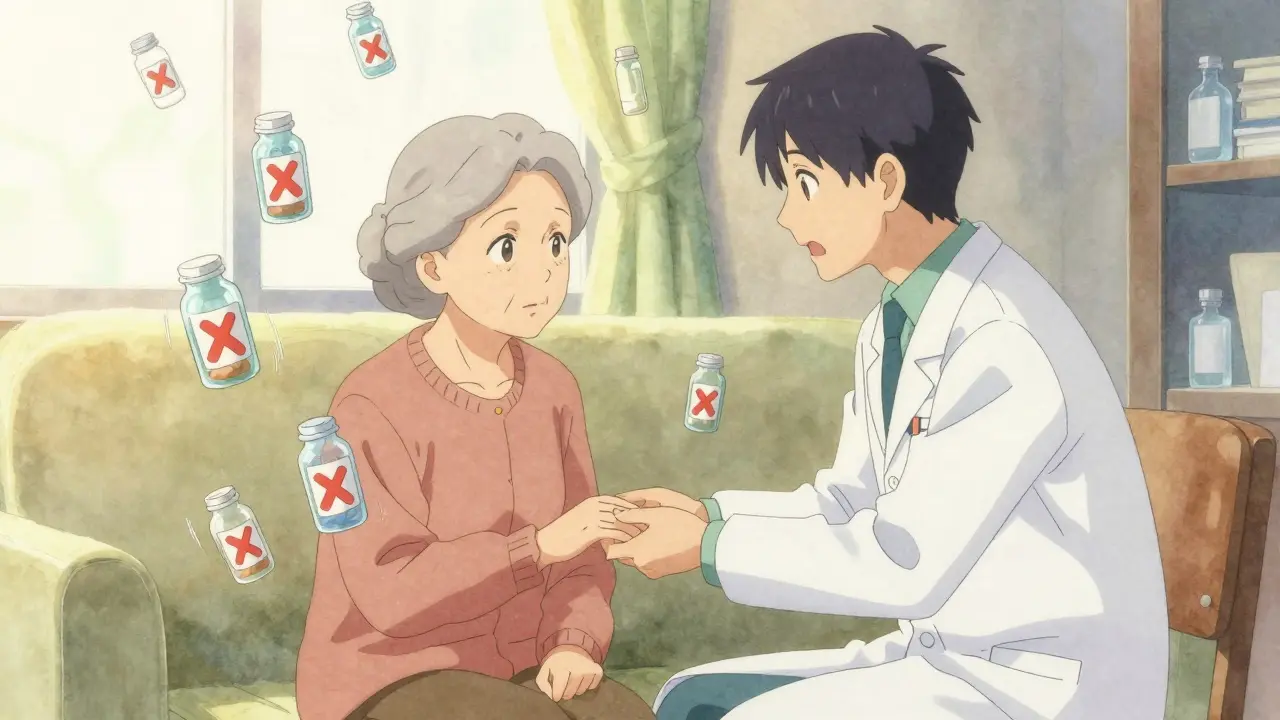
Older adults are taking more medications than ever. By 2025, nearly 41% of Americans aged 65 and older are on five or more prescriptions daily. That’s not just common-it’s dangerous. Each extra pill increases the risk of falls, confusion, kidney damage, and hospitalization. And here’s the hard truth: many of these drugs aren’t helping anymore. They’re just adding risk.
Why Polypharmacy Is a Silent Crisis
Polypharmacy isn’t just about having too many pills. It’s about taking drugs that no longer match a person’s health goals, life expectancy, or actual needs. For someone with advanced dementia, a statin to lower cholesterol might not be worth the risk of muscle pain or liver stress. For a frail 82-year-old with limited mobility, a blood thinner for a past atrial fibrillation episode might be doing more harm than good. The numbers don’t lie. Patients taking more than four medications have a 30-50% higher chance of falling and breaking a bone. Each additional drug bumps that risk up by about 8%. And in the U.S., nearly 28% of hospital admissions among older adults are caused by medication problems-many of them preventable. The problem isn’t just doctors prescribing too much. It’s fragmented care. One doctor treats heart disease. Another handles arthritis. A third manages diabetes. None of them see the full picture. Medication lists get outdated. Side effects get ignored. And patients rarely speak up-68% of older adults are afraid to ask if they can stop a pill.What Actually Works: The Three Levels of Intervention
Not all medication reviews are created equal. Research shows only one type delivers real results: Type III Comprehensive Medication Reviews.- Type I just looks at the list of drugs. No patient talk. No context. Doesn’t work.
- Type II adds a check on whether the patient is taking the meds. Still doesn’t fix the problem.
- Type III includes a face-to-face or video visit where a pharmacist or doctor asks: Why are you on this? Is it still helping? What are you afraid to stop? This is the only approach proven to cut hospital readmissions by 18.3%.
Tools That Guide the Right Decisions
Clinicians don’t guess. They use validated tools. Three stand out:- Beers Criteria (2023)-lists drugs to avoid in older adults, like benzodiazepines and certain anticholinergics. Widely known, but alone, it doesn’t improve outcomes.
- STOPP/START (v3, 2021)-STOPP finds inappropriate drugs. START finds drugs that should be added but aren’t. This is the only tool proven to reduce hospitalizations in clinical trials.
- FORTA List-classifies drugs as A (strongly recommended), B (recommended), C (caution), or D (avoid) based on age and condition. Used heavily in Europe, now gaining ground in the U.S.

Who Should Lead the Charge?
Pharmacists aren’t just dispensers. They’re the frontline in polypharmacy reduction. When pharmacists work under Collaborative Practice Agreements (CPAs)-which let them adjust or stop meds with physician approval-deprescribing rates jump by 37.6% compared to physician-only efforts. But here’s the catch: only 22 U.S. states allow CPAs for pharmacists to manage geriatric meds. In the rest, even the best pharmacist can’t make changes without waiting days for a doctor’s signature. That delay kills momentum. The Veterans Health Administration (VA) got it right. They embedded geriatric pharmacists into every clinic. Result? A 26.8% drop in inappropriate prescriptions. Academic medical centers with similar models report 42.6% more drug-related problems resolved. Primary care? It’s struggling. Most doctors have less than five minutes per patient to review meds. And only 15% of Medicare Advantage plans pay for a full medication review. No reimbursement. No time. No change.The Hidden Danger: Undertreatment
Polypharmacy isn’t just about too many drugs. It’s also about too few. One in three older adults isn’t getting medications they actually need. Think about it: a patient with heart failure might be on five drugs for blood pressure and diabetes-but not on a diuretic or beta-blocker because their doctor forgot. Or someone with osteoporosis isn’t on a bone-strengthening drug because no one checked their fracture risk. Dr. Joseph Hanlon calls this the double-edged sword of geriatric prescribing. You can’t just cut. You have to balance. Deprescribing must be paired with re-prescribing when needed. Ignoring undertreatment leads to preventable strokes, fractures, and infections.
Technology Is Changing the Game
In 2024, Epic Systems rolled out a new tool: the Polypharmacy Risk Score. It uses AI to scan electronic health records and flag patients at high risk for adverse events. In testing, it predicted drug-related hospitalizations with 87.3% accuracy. This isn’t sci-fi. It’s now in use in hospitals across the country. The system looks at age, kidney function, drug interactions, recent hospital stays, and even pharmacy refill patterns. It doesn’t decide-but it points the way. The American Geriatrics Society is also working on Beers Criteria v2026, which will include automated deprescribing algorithms. By 2026, EHRs may auto-suggest: “Patient on 8 meds. Gabapentin and amitriptyline both for neuropathy. Consider stopping one. Risk of dizziness: high.”What Gets in the Way?
Even with the right tools and people, barriers remain:- Fragmented care-78% of older adults see five or more providers a year. No one has the full list.
- Poor documentation-only 33% of EHRs track whether patients are actually taking their meds.
- Patient fear-many think stopping a pill means their condition is worsening. They don’t know deprescribing can improve quality of life.
- Wrong speed-rushing to stop meds causes 12.4% of patients to have withdrawal symptoms or disease flare-ups. Tapering matters.
- Starting with a full medication reconciliation (takes about 23 minutes per patient).
- Using STOPP/START to identify problems.
- Engaging the patient: “What’s your biggest concern right now? Let’s see if we can make that better.”
- Building a team: pharmacist, nurse, social worker, and primary doctor-all talking to each other.
What’s Next?
By 2030, comprehensive medication reviews won’t be optional. They’ll be standard. Medicare is already moving that way. Starting in 2024, providers get penalized if more than 30% of their Medicare patients are on ten or more drugs. Early adopters are seeing results: 19.3% higher patient satisfaction and 27.6% lower total care costs. That’s not just good medicine. It’s smart economics. The goal isn’t to reduce pill count. It’s to reduce harm. To help older adults live better, not just longer. To make sure every drug has a reason to be there-and that no one is left behind because no one asked.What is considered polypharmacy in older adults?
Polypharmacy is generally defined as taking five or more medications regularly. This threshold is used by major organizations like the American Geriatrics Society and the American Academy of Family Physicians. It’s not just about the number-it’s about whether each drug is still appropriate for the person’s current health, goals, and life expectancy.
Can stopping medications really improve health in older adults?
Yes, when done carefully. Studies show that appropriate deprescribing reduces falls, confusion, kidney stress, and hospital visits. For example, stopping unnecessary sedatives or antipsychotics in dementia patients often improves alertness and mobility. The key is individualization-removing drugs that no longer provide benefit, not all drugs.
Who should lead medication reviews for seniors?
Pharmacists trained in geriatrics are the most effective leaders. They have the time, tools, and expertise to review drug interactions, adherence, and appropriateness. When they work under Collaborative Practice Agreements, they can adjust or stop medications directly, which improves outcomes significantly. Physicians should be involved, but pharmacists should lead the review process.
What tools do clinicians use to decide which drugs to stop?
The most effective tools are STOPP/START (v3, 2021) and the FORTA list. STOPP identifies potentially inappropriate medications, while START finds drugs that should be added but aren’t. The Beers Criteria is useful for flagging dangerous drugs, but alone, it doesn’t improve health outcomes. The best approach combines these tools with patient goals and clinical judgment.
Why don’t more doctors do medication reviews?
Time and money. Most primary care doctors have less than five minutes per patient to review meds. Medicare doesn’t pay for comprehensive reviews in most plans-only 15% of Medicare Advantage plans reimburse for them. Without payment or time, even well-intentioned providers can’t make changes.
Is artificial intelligence being used to reduce polypharmacy?
Yes. Systems like Epic’s Polypharmacy Risk Score use AI to scan patient records and flag high-risk combinations. In testing, it predicted adverse drug events with 87.3% accuracy. These tools don’t make decisions-they help clinicians spot hidden risks faster. By 2026, AI-driven alerts will be built into most major electronic health records.
Lance Nickie
January 15, 2026 AT 07:04Gregory Parschauer
January 15, 2026 AT 17:08Let’s be clear-this isn’t ‘medication management.’ It’s pharmaceutical negligence disguised as clinical practice. The Beers Criteria has been around for decades, yet we’re still seeing 82-year-olds on gabapentin for ‘sleep’ while their kidneys scream for mercy. This isn’t an epidemic-it’s a systemic failure of accountability. And don’t even get me started on the fact that 68% of patients are too afraid to ask if they can stop a drug. That’s not patient compliance-it’s learned helplessness bred by a system that treats elders like passive recipients of chemical cocktails.
Pharmacists under CPAs are the only viable solution, and yet we’re still debating whether they should have prescriptive authority? In Canada, we’ve had this model since 2015. Outcomes improved. Hospitalizations dropped. Mortality flattened. Yet here in the U.S., we’re still stuck in the Stone Age of ‘doctor knows best.’ It’s not ignorance. It’s institutional cowardice.
And let’s not romanticize ‘shared decision-making’ when the patient doesn’t even have access to their own med list. EHRs still can’t track adherence? That’s not a tech issue-that’s a moral one. We’re literally flying blind while prescribing anticholinergics to dementia patients like they’re placebo candy. This isn’t medicine. It’s mass harm with a white coat.
The FORTA list? Brilliant. STOPP/START? Essential. But none of it matters if we don’t fund the damn reviews. Medicare pays for a CT scan in 12 minutes but won’t cover 23 minutes of a pharmacist’s time to save someone’s life? That’s not a policy gap. That’s a death sentence wrapped in bureaucracy.
Milla Masliy
January 16, 2026 AT 05:39I’ve seen this play out with my mom. She was on 11 meds-some for things she didn’t even have anymore. The pharmacist who did her review actually cried when she realized one of the pills was for a heart condition she’d recovered from 7 years ago. We stopped three right away. She started sleeping better, stopped falling, and even joined a book club again. It wasn’t magic. It was just someone listening.
Doctors are overworked. Pharmacists are underused. And patients? They’re just trying not to die from their own medicine. We need more teams-not more prescriptions. Let pharmacists lead. Let them adjust. Let them talk. It works. I’ve seen it.
Damario Brown
January 18, 2026 AT 02:23yo so like the whole ‘type iii review’ thing is just a fancy way of saying ‘ask the patient what they think’? wow. groundbreaking. also why is everyone acting like pharmacists are saints? i’ve seen pharmacists just delete meds like they’re deleting spam emails. one guy took away my grandpa’s blood pressure med because ‘he’s 92’-but he was still walking 2 miles a day. now he’s dizzy all day. so much for ‘evidence-based.’
also stopp/start? sounds like a bad video game. and beers criteria? that’s just a list of drugs doctors already know they shouldn’t prescribe. why are we acting like this is new info? it’s not rocket science. it’s common sense. and common sense doesn’t need 3 acronyms and an AI to tell you not to give benzos to grandma.
sam abas
January 18, 2026 AT 15:46Look, I get it-polypharmacy is a problem. But let’s not pretend this is a novel insight. The American Geriatrics Society published the Beers Criteria in 2012. The STOPP/START guidelines were refined in 2015. The FORTA list was introduced in 2018. We’ve known this for over a decade. So why are we still having this conversation? Because the system is designed to incentivize volume, not value. Every pill prescribed generates revenue. Every review takes time and doesn’t get reimbursed. It’s not a clinical failure-it’s an economic one.
And AI? Epic’s Polypharmacy Risk Score? It’s a band-aid. AI doesn’t understand context. It doesn’t know that Mrs. Jenkins stopped her statin because she didn’t want to lose her mobility, not because she’s noncompliant. It doesn’t know that her son is her primary caregiver and that she’s terrified of being sent to a nursing home. Algorithms can flag risk, but they can’t replace empathy. And we’re replacing empathy with dashboards.
Also, let’s not forget undertreatment. I’ve seen patients with heart failure denied beta-blockers because the doctor was scared of hypotension. Then they got hospitalized for fluid overload. So we’re swinging from overmedication to undertreatment because we don’t have the bandwidth to do the hard work of balancing. It’s not about fewer pills. It’s about better decisions. And that requires training, time, and trust. We have none of those.
John Pope
January 19, 2026 AT 05:24Here’s the uncomfortable truth nobody wants to say: we’re not treating patients. We’re treating data points. The 82-year-old with dementia isn’t a person who wants to watch sunsets and eat ice cream-she’s a ‘high-risk polypharmacy candidate’ in an EHR. The 90-year-old with cancer? Not a man who just wants to play with his grandkids without nausea. He’s a ‘medication burden’ statistic.
We’ve outsourced humanity to algorithms and checklists. STOPP/START? FORTA? Beers? These aren’t tools-they’re shields. Shields behind which doctors hide from the moral weight of their choices. ‘I followed the guidelines,’ they say. But guidelines don’t hold a hand when someone cries because they’re scared to stop their pills. Guidelines don’t explain why stopping a drug might mean living better, not just longer.
And let’s be real-pharmacists aren’t heroes. They’re the last line of defense because the system failed everyone else. We’ve turned healthcare into a pyramid scheme: the patient is at the bottom, the nurse is in the middle, and the doctor is at the top, collecting fees while the pharmacist cleans up the mess. It’s not a system of care. It’s a system of damage control.
Clay .Haeber
January 20, 2026 AT 00:43Oh wow, another ‘epic’ AI tool to ‘solve’ polypharmacy. Next they’ll invent a robot that tells grandma her pills are ‘not vibe-checking’ today.
Let me guess-the 15% of Medicare Advantage plans that pay for reviews? They’re the same ones that charge $200 for a 7-minute telehealth visit where the doctor says ‘take two aspirin and call me in 2027.’
And don’t get me started on ‘collaborative practice agreements.’ That’s just corporate-speak for ‘we’re too lazy to train our own doctors so we’ll outsource the hard work to pharmacists who can’t even write prescriptions in 28 states.’
Meanwhile, my aunt’s doctor just added a new antidepressant because she ‘seemed down.’ She’s 87, her husband died last year, and she hasn’t left the house in 6 months. But hey-let’s throw another pill at it. Because obviously, grief is just a serotonin deficiency.
Also, ‘de-prescribing’? Sounds like a diet plan for pills. ‘Keto Meds: Lose 4 Pills in 30 Days!’
Priyanka Kumari
January 20, 2026 AT 20:08As someone who works with elderly patients in India, I’ve seen both sides. In rural areas, they often take nothing-because they can’t afford it. In cities, they take 8+ pills because doctors prescribe them like candy. The real issue isn’t just the number-it’s the lack of continuity. No one tracks what’s taken. No one asks how they feel. No one sits down.
But here’s what works: community health workers who visit weekly. A simple notebook where patients write down their meds and how they feel. A pharmacist who calls every month. No fancy AI. No EHRs. Just care.
We don’t need more tools. We need more people who care enough to listen. And we need to stop treating older adults like broken machines that need fixing. They’re people. With memories. With fears. With dreams. And sometimes, the best medicine is just someone saying, ‘It’s okay to stop.’
Avneet Singh
January 21, 2026 AT 05:09Let’s be honest-the entire geriatric pharmacology field is a glorified exercise in confirmation bias. STOPP/START? That’s just a checklist for lazy clinicians who don’t want to think. FORTA? A marketing tool for pharma companies who want to rebrand their drugs as ‘age-appropriate.’ Beers Criteria? A relic from the 90s that ignores comorbidities and functional status.
And don’t even mention AI. Epic’s risk score? It’s trained on biased datasets-mostly white, urban, Medicare patients. What about rural Black elders? Indigenous seniors? Those with limited English? The algorithm doesn’t see them. It just sees ‘high risk’ and recommends deprescribing… but never re-prescribing. Undertreatment? Not in the training data. So it ignores it.
Real solution? Pay doctors to spend 45 minutes with each elderly patient. Not 23. Not 15. 45. And make them sit with the patient, not the screen. But that’s too expensive. So we’ll keep letting pharmacists do the emotional labor while everyone else collects their fees.
Adam Vella
January 22, 2026 AT 15:41It is imperative to recognize that the current paradigm of geriatric pharmacotherapy is fundamentally misaligned with the principles of evidence-based medicine. The proliferation of polypharmacy is not merely a clinical issue but a structural failure of healthcare delivery systems predicated on fee-for-service reimbursement models that incentivize intervention over observation.
Furthermore, the reliance on algorithmic tools such as STOPP/START and FORTA, while methodologically sound, lacks the necessary contextual integration required for individualized patient care. The conflation of guideline adherence with therapeutic efficacy is a dangerous fallacy. Guidelines are not mandates; they are heuristic frameworks. Their utility is contingent upon clinical judgment, which remains irreplaceable.
Moreover, the assertion that pharmacists should lead medication reviews is not without merit; however, it presupposes a level of interprofessional collaboration that is largely absent in most primary care settings. Until interdisciplinary teams are formally integrated into reimbursement structures and EHR workflows, any intervention will remain fragmented and suboptimal.
It is therefore not sufficient to advocate for policy change-we must reconstruct the epistemology of geriatric care to prioritize longitudinal, patient-centered outcomes over episodic, pill-count metrics.
Alan Lin
January 23, 2026 AT 01:36I’ve spent 18 years as a nurse in a geriatric unit. I’ve seen patients die from side effects of drugs they didn’t need. I’ve seen others wake up for the first time in years after we stopped their antipsychotic. I’ve held hands while families cried because they didn’t know they could ask to stop meds.
But here’s what nobody tells you: it’s not the doctors’ fault. They’re drowning. They’re told to hit quality metrics, see 30 patients a day, and document every click. No one gives them time to review a med list. No one pays them to sit down and ask, ‘What do you want your life to look like?’
So yes-pharmacists need authority. Yes-AI should flag risks. Yes-we need better tools.
But what we really need is a system that says: ‘Your time with this patient matters.’ Not the number of pills you prescribe. Not the revenue you generate. The time you spend listening. That’s the cure. And we’ve forgotten how to give it.
Scottie Baker
January 23, 2026 AT 04:34Milla Masliy
January 23, 2026 AT 22:37That’s exactly what happened with my mom. The pharmacist asked her, ‘What’s the one thing you wish you could do without feeling dizzy?’ She said, ‘Walk to the mailbox without holding onto the fence.’ We stopped the sleep aid and the antihistamine. She’s been walking to the mailbox every morning since.
It’s not about cutting pills. It’s about giving people back their lives.