

Insulin Stacking: How to Avoid Dangerous Hypoglycemia from Too-Soon Insulin Doses
 Mar, 13 2026
Insulin Timing Calculator
This tool helps you determine if you're at risk of insulin stacking by calculating the safe interval between insulin doses based on insulin type and timing.
Results
Every year, thousands of people with diabetes end up in the emergency room because their blood sugar dropped too low-not because they skipped a meal, but because they gave themselves another insulin shot too soon. This is called insulin stacking, and it’s one of the most common-and preventable-mistakes in insulin therapy. If you’re using rapid-acting insulin to manage meals or correct high blood sugar, you need to understand how long that insulin stays active. Give another dose before it’s done working, and you’re stacking insulin on top of itself. The result? A dangerous drop in blood sugar that can leave you shaking, confused, or unconscious.
What Exactly Is Insulin Stacking?
Insulin stacking happens when you give a second or third dose of rapid-acting insulin before the first dose has finished working. It’s not about taking too much insulin overall-it’s about timing. Most people think if their blood sugar is still high two hours after a meal, they just need another shot. But that first shot is still lowering their blood sugar. Adding more insulin on top of it pushes their levels way too low.
Rapid-acting insulins like insulin lispro (Humalog), insulin aspart (NovoLog), and insulin glulisine (Apidra) start working in about 15 minutes, peak around 60 to 90 minutes, and keep working for 3 to 5 hours. That means if you took a correction dose at 7 p.m., and then another at 9 p.m., you’re doubling up on insulin that’s still active. By midnight, your body has way more insulin than it needs. That’s when blood sugar crashes-often overnight, when you’re asleep and can’t react.
This isn’t just a theory. A 2022 study from the Veterans Affairs Greater Los Angeles Healthcare System found that 37% of overnight low blood sugar episodes in hospitalized patients were directly caused by insulin doses given within four hours of each other. The same study showed that when people waited at least four hours between doses, those events dropped by nearly half.
Why This Is So Dangerous
Hypoglycemia isn’t just uncomfortable. It’s life-threatening. When your blood sugar falls below 70 mg/dL, your brain doesn’t get enough fuel. You might feel shaky, sweaty, or anxious. But if it drops further-say, to 40 or 50 mg/dL-you can lose consciousness, have a seizure, or even suffer brain damage. According to a 2021 study in JAMA Internal Medicine, people who experience severe hypoglycemia are 2.5 times more likely to die prematurely than those who don’t.
And insulin stacking is a major reason why this happens. The NIH reported in 2024 that patients who stack insulin have a 50% higher chance of having a true hypoglycemic event (blood sugar under 70 mg/dL) compared to those who space out their doses properly. Real-world stories back this up. On diabetes forums, users describe waking up at 3 a.m. with heart palpitations, or finding their CGM reading 42 mg/dL after giving two correction doses within three hours. One Reddit user said, “I gave three boluses in three hours trying to fix my sugar from 300. Woke up shaking at 50.” That’s not luck-it’s a direct result of stacking.
Different Insulins, Different Risks
Not all insulins behave the same way. Understanding the difference between types is key to avoiding stacking.
Rapid-acting insulins (lispro, aspart, glulisine) are the main culprits. They’re fast, but they don’t disappear quickly. Their activity window is 3-5 hours. Giving another dose within that time? That’s stacking.
Regular insulin (Humulin R, Novolin R) is slower. It starts working in 30 minutes, peaks around 2-4 hours, and lasts 5-8 hours. That means you need to wait even longer between doses-sometimes up to 6 hours-to avoid stacking.
Basal insulins like glargine (Lantus) or degludec (Tresiba) are different. These are designed to provide steady background insulin all day. You take them once a day, and they don’t “stack” like rapid-acting insulins. In fact, degludec has a half-life of 25 hours and reaches steady state after three days of consistent dosing. The risk here isn’t stacking-it’s inconsistent dosing. Skipping a basal dose or taking it at wildly different times each day causes bigger problems than giving too much at once.
The big mistake? People confuse basal and bolus insulin rules. You can’t treat a high blood sugar at breakfast with a basal insulin. And you shouldn’t give a basal insulin every 12 hours thinking it’s like a rapid-acting shot. Basal insulins are meant to be consistent, not corrected.
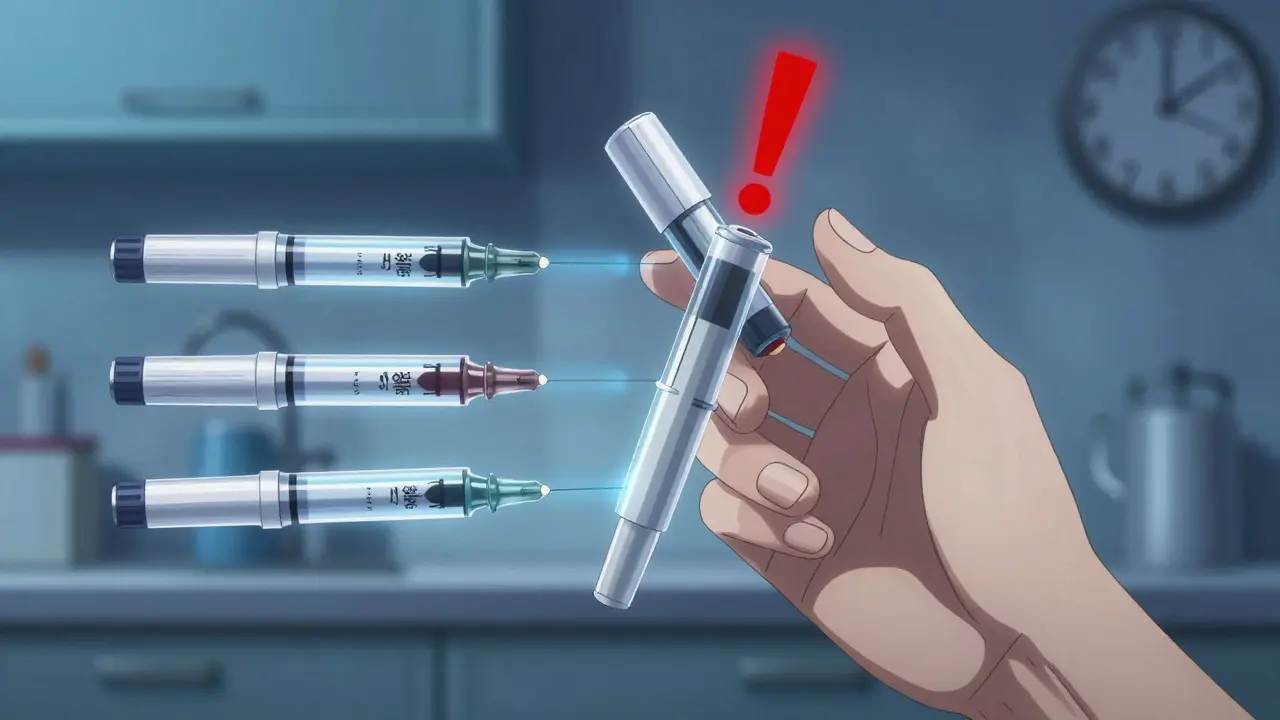
How to Prevent Insulin Stacking
Preventing insulin stacking comes down to three things: timing, tracking, and technology.
Wait at least 4 hours between correction doses of rapid-acting insulin. That’s the standard guideline from the American Diabetes Association’s 2023 Standards of Medical Care. If you gave insulin at 1 p.m., don’t give another until at least 5 p.m.-unless you’ve checked your insulin on board (IOB) and know how much is still active.
Track every dose. If you’re on multiple daily injections (MDI), keep a log. Write down the time and amount of every bolus. Use a notebook, a spreadsheet, or a diabetes app. Without this, you’re guessing-and guessing with insulin is risky.
Use technology. Modern insulin pumps and CGMs have built-in tools to stop stacking before it happens. Devices like the Tandem t:slim X2 and Omnipod 5 calculate your insulin on board (IOB) in real time. If you try to give a correction dose too soon, the pump will warn you: “You still have 1.2 units active. Wait 90 minutes.” Some even block the dose entirely. These aren’t luxury features-they’re safety features.
For people not using pumps, standalone bolus calculators like the BolusGuard device cost $200-$300 and do the same thing. You enter your current blood sugar, carbs, and last insulin dose. It tells you exactly how much more (if any) you need. No more guessing.
What About CGMs and Personalized Timing?
Continuous glucose monitors (CGMs) are game-changers. They don’t just show your current number-they show your trend. If your sugar is falling fast, you don’t need more insulin. If it’s flatlining, you might need a little. But even more important: CGMs reveal how your body responds to insulin.
Not everyone’s insulin works the same. The standard model says rapid-acting insulin lasts 4 hours. But the DIAMOND trial in 2022 found that 22% of users had insulin activity lasting more than 5 hours. That’s not rare. It’s common. If you have kidney issues, your insulin clears even slower-up to 30% slower. That means your personal “safe window” might be 5 or even 6 hours.
Don’t rely on general rules. Use your CGM data over 2-3 months to see how long your insulin actually lasts. Look at your glucose trend after each bolus. If your sugar keeps dropping 4 hours after a dose, you’re likely still active. Adjust your timing accordingly.

Why Most People Don’t Know About This
Insulin stacking isn’t taught in most diabetes education classes. Nurses, even in hospitals, often miss it. The same Veterans Affairs study found that 68% of nursing staff didn’t recognize insulin stacking as the cause of overnight lows. Patients aren’t told to track their insulin timing. They’re told, “If your sugar’s high, give more insulin.” That’s dangerous advice.
And it’s expensive. Hypoglycemia-related hospitalizations cost the U.S. healthcare system $1.1 billion a year, and nearly one-third of those are from insulin stacking. The FDA now requires all new insulin delivery systems to include stacking alerts. But if you’re using old pumps or injections without a CGM, you’re flying blind.
What You Can Do Right Now
Here’s how to protect yourself today:
- If you take rapid-acting insulin, assume it lasts 4 hours. Don’t give another dose before then.
- Use your CGM trend arrow. If your sugar is falling, don’t give insulin.
- Write down every bolus time and dose. Even for a few weeks.
- Ask your doctor about an IOB calculator. If you’re on a pump, make sure it’s turned on.
- If you’re not using a CGM, consider one. People without CGMs have 3.2 times more stacking-related lows.
Insulin stacking isn’t about being careless. It’s about not knowing how insulin works in your body. Once you understand the timing, you can take control. And that’s the difference between a dangerous low-and a safe, stable day.
Jimmy V
March 14, 2026 AT 19:13Richard Harris
March 15, 2026 AT 18:46Kandace Bennett
March 16, 2026 AT 05:19Tim Schulz
March 16, 2026 AT 15:38Jinesh Jain
March 18, 2026 AT 07:20Sabrina Sanches
March 20, 2026 AT 06:24Shruti Chaturvedi
March 21, 2026 AT 19:06Katherine Rodriguez
March 22, 2026 AT 13:48