

Insurance Formulary Tiers Explained: Tier 1, Tier 2, Tier 3, and Non-Formulary Drugs
 Dec, 1 2025
When you pick up a prescription, you expect to pay a set amount - maybe $10, maybe $30. But what if that same drug costs $150 next month? Or worse - your plan doesn’t cover it at all? That’s where insurance formulary tiers come in. They’re the hidden system that decides how much you pay for your meds, and most people don’t understand them until they get hit with a surprise bill.
What Is a Formulary, Anyway?
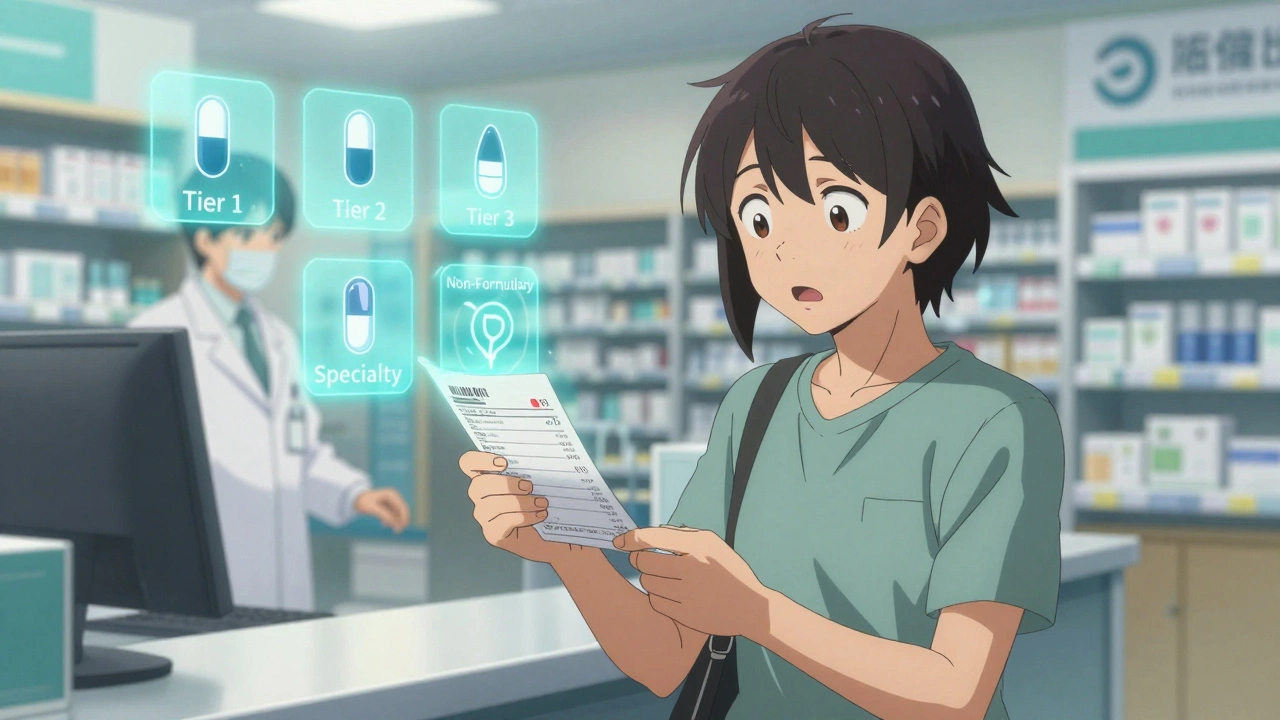
A formulary is just a list of drugs your health plan will pay for. But it’s not a simple yes-or-no list. It’s broken into tiers - like levels in a video game - each with its own price tag. The goal? Get you to use cheaper, effective drugs first. The reality? It can make filling prescriptions confusing, stressful, and sometimes impossible.Most plans use three to five tiers. Some even have a sixth for the most expensive specialty drugs. But no matter the number, the structure works the same: lower tiers = lower cost. Higher tiers = higher cost. And then there’s non-formulary - the land where your drug isn’t covered at all.
Tier 1: The Cheap and Common
Tier 1 is where you want to be. This tier is almost always made up of generic drugs - the same active ingredients as brand-name pills, but sold for a fraction of the price. Think metformin for diabetes, lisinopril for high blood pressure, or atorvastatin for cholesterol.For most commercial plans, Tier 1 copays range from $0 to $15 for a 30-day supply. Medicare Part D plans often have $0 copays on Tier 1 generics. That’s not a typo. You pay nothing.
Why are these drugs so cheap? Because generics have been around long enough that patents expired. Multiple companies make them. Competition drives prices down. Insurers negotiate hard with manufacturers - and win. The result? You get the same medicine, at a price that won’t break your budget.
Tier 2: Preferred Brand-Name Drugs
Tier 2 is where you find brand-name drugs that your plan still likes. These aren’t generics, but they’ve earned a spot on the preferred list because they’re effective, have good safety records, or come with strong rebates from the manufacturer.Common examples include asthma inhalers like Advair, antidepressants like Lexapro, or cholesterol drugs like Crestor. These aren’t the cheapest options, but they’re the cheapest brand-name options your plan will cover.
Costs here? Typically $20 to $40 per 30-day fill. That’s still manageable for most people. But here’s the catch: if your doctor prescribes a brand-name drug that’s not on Tier 2, you might get stuck with a much higher bill.
Tier 3: Non-Preferred Brand-Name Drugs
Tier 3 is where things start to hurt. These are brand-name drugs that your plan doesn’t prefer - often because cheaper alternatives exist, or the manufacturer didn’t offer a big enough rebate.Let’s say your doctor prescribes a specific brand of blood pressure medication. Your plan has three similar drugs. Two are on Tier 2. This one? It’s on Tier 3. Copays jump to $50-$100. Suddenly, that $30 monthly cost becomes $80. And if you don’t know the difference, you’ll just pay it.
Many patients don’t realize their drug moved from Tier 2 to Tier 3. Plans can change tiers quarterly. One month, your drug costs $30. The next, $90. No warning. No email. Just a higher bill at the pharmacy.
And it’s not just about price. Some Tier 3 drugs require prior authorization - your doctor has to prove you’ve tried cheaper options first. That can delay treatment by days or weeks. For someone with chronic pain or anxiety, that delay can be dangerous.

Tier 4 and 5: Specialty Drugs - The Hidden Cost Trap
Not all plans have five tiers, but if yours does, Tiers 4 and 5 are where the real financial shockers live. These are specialty drugs - often used for cancer, rheumatoid arthritis, multiple sclerosis, or rare diseases.These aren’t pills you pick up at the corner pharmacy. They’re injectables, infusions, or complex oral therapies that cost hundreds or even thousands per month. Examples include Humira, Enbrel, or Spinraza.
Instead of a flat copay, you pay coinsurance - a percentage of the drug’s total cost. That could be 25%, 33%, or even 50%. So if your drug costs $8,000 a month, your share is $2,000-$4,000. Even with insurance, that’s more than most people make in a week.
And here’s the kicker: many of these drugs are only available through specialty pharmacies. You can’t just walk in and pick them up. You have to order them, wait for delivery, and sometimes deal with complex paperwork just to get started.
Non-Formulary: The Drug Your Plan Won’t Cover
Non-formulary means your drug isn’t on the list at all. Your plan won’t pay for it. Not a cent.This happens when:
- There’s a cheaper, equally effective drug already on the formulary
- The manufacturer didn’t negotiate a deal with your insurer
- The drug is new and hasn’t been reviewed yet
- The plan considers it experimental or not medically necessary
Imagine your doctor prescribes a new migraine medication. You’re excited - it’s supposed to be better than anything you’ve tried. But when you go to fill it, the pharmacist says, “We don’t cover this.” You’re out of luck unless you pay full price - which could be $1,000 or more.
Some plans allow you to request an exception. Your doctor writes a letter explaining why you need this specific drug. But approval isn’t guaranteed. And even if you get it, the process can take up to two weeks. That’s two weeks without treatment.
Why Do Formularies Even Exist?
Insurance companies didn’t create tiers to make your life harder. They did it to control costs. Drug prices in the U.S. are the highest in the world. In 2022, Americans spent over $620 billion on prescriptions. Without formularies, those costs would be even higher - and passed on to you in higher premiums.Tiered formularies have worked. Medicare Part D saved $14.7 billion in 2022 just through preferred brand tiers. Generic drugs in Tier 1 cost an average of $1.27 per prescription. The same drug in Tier 3? $58.72.
But the trade-off is real. A 2022 study found that 41% of patients delayed or skipped meds because they couldn’t afford Tier 4 or 5 drugs. For people with chronic conditions, that’s not just inconvenient - it’s life-threatening.

How to Navigate Your Formulary
You can’t change your plan’s formulary. But you can learn to work with it.- Check your plan’s formulary before you fill a new prescription. Most insurers have a searchable tool online. Look for your drug by name - not just the brand, but the generic too.
- Ask your doctor: “Is there a Tier 1 or Tier 2 alternative?” Sometimes, switching to a different drug in the same class saves you hundreds.
- Know the difference between copay and coinsurance. A $30 copay is predictable. A 30% coinsurance on an $8,000 drug? That’s a nightmare.
- Set up alerts. Many plans send emails when a drug changes tiers. Turn them on.
- If you’re hit with a surprise cost, ask for a formulary exception. Your doctor can help. Many people get approved - especially if they’ve tried cheaper options first.
Medicare beneficiaries can use the Plan Finder tool on Medicare.gov. Commercial plan members should check their insurer’s website - Humana, UnitedHealthcare, and CVS Caremark all have drug cost calculators.
The Big Problem: Lack of Transparency
Here’s the truth no one talks about: you don’t know why a drug is in a certain tier. Not really.Insurers and pharmacy benefit managers (PBMs) decide tier placement based on rebates, not just clinical effectiveness. A drug might be on Tier 2 not because it’s better - but because the manufacturer paid a big rebate. A cheaper drug might be on Tier 3 because the maker didn’t offer a deal.
A 2023 study found only 32% of health plans explain how they assign tiers. That means you’re guessing. And guessing when it comes to your health isn’t safe.
What’s Changing in 2025?
The Inflation Reduction Act of 2022 capped insulin at $35 per month - regardless of tier. That’s a big win. And starting in 2024, Medicare Part D introduced a new catastrophic phase that lowers out-of-pocket costs for high-tier drugs. By 2025, more states are expected to follow with similar caps on other expensive meds.Some insurers are testing “value-based tiers” - where drugs are grouped by how well they work, not just how much they cost. That could be a game-changer. But it’s still early.
For now, the system remains complex. And the burden still falls on you - the patient - to figure it out.
Final Advice: Don’t Assume, Ask
Never assume your drug is covered. Never assume the price won’t change. Always check your formulary before you fill a prescription - even if you’ve taken the same drug for years.If you’re struggling to afford your meds, talk to your pharmacist. They know the system. They’ve seen this before. They can help you find alternatives, apply for patient assistance programs, or file an exception request.
And if your plan keeps changing tiers without warning? Call your insurer. File a complaint. You’re not alone. Thousands of people face the same problem every month. The system isn’t broken - it’s just designed to save money, not to make sense.
Know your tiers. Know your rights. And don’t pay more than you have to.
Declan Flynn Fitness
December 1, 2025 AT 19:39Been there, done that. My dad’s on five different meds and half of them jumped from $15 to $80 overnight with zero warning. Pharmacies don’t call, insurers don’t text - you just get slapped with a bill that makes you question if you’re still alive. Always check the formulary. Always. Even if you’ve taken it for 10 years.
Michelle Smyth
December 3, 2025 AT 16:51Ah yes, the neoliberal pharmacoeconomic ballet - where rebate-driven tiering masquerades as clinical efficacy. The real tragedy isn’t the cost, it’s the epistemic violence of reducing human health to actuarial tables disguised as ‘formularies.’ One wonders if the PBM executives even remember what a pill looks like.
Patrick Smyth
December 4, 2025 AT 19:00I cried when my insulin went from $20 to $400. I didn’t even know what a formulary was until I had to choose between eating and breathing. My wife had to work two jobs just to keep me alive. This isn’t healthcare. This is a blood sport.
Jeremy Butler
December 5, 2025 AT 16:37It is incumbent upon the patient to assume a position of epistemic vigilance vis-à-vis their formulary structure. The absence of transparency is not an accident but a structural feature of the current pharmaceutical-industrial complex, wherein the alignment of incentives between PBMs and insurers systematically disadvantages the end-user. One must therefore engage in proactive due diligence.
Courtney Co
December 6, 2025 AT 12:11Wait so you’re telling me I’m supposed to read through 50 pages of tiny print just to find out if my anxiety med is covered? And if I don’t, I get charged $2000? That’s not insurance. That’s a trap. I’m done. I’m switching to herbal tea and hoping for the best.
Shashank Vira
December 7, 2025 AT 09:22Formularies are merely the surface manifestation of a deeper ontological crisis in Western medicine - the commodification of biological necessity. When life-saving molecules are subjected to market logic, the very notion of care becomes a performative illusion. The Tier 3 patient is not merely underinsured - they are ontologically erased.
Eric Vlach
December 8, 2025 AT 10:47Biggest tip I ever got - talk to your pharmacist. Not your doctor, not your insurer. The pharmacist. They know which drugs are secretly on Tier 2, which ones have patient coupons, which ones you can split to save cash. I saved $600/month just by asking. Seriously. Just walk in and say ‘hey, any tricks?’ They’ll help you.
Souvik Datta
December 10, 2025 AT 02:35Let me tell you something - this system isn’t broken, it’s working exactly as designed. But here’s the good news: you’re not powerless. I’ve helped over 20 people in my village get their meds covered just by filing exceptions with their doctors. It takes time. It takes paperwork. But it works. Don’t give up. Your life matters more than their spreadsheets.
Priyam Tomar
December 10, 2025 AT 19:10Everyone’s crying about Tier 3 but nobody talks about how 90% of these drugs are overpriced junk anyway. Why are we even using brand-name statins when generics work better? The real problem is doctors prescribing expensive crap because they got free lunches from pharma reps. Blame the prescribers, not the formulary.
Jack Arscott
December 12, 2025 AT 14:38Just found out my migraine med moved to non-formulary 😭 I cried for 20 mins. Then I called my doc and we switched to a Tier 2. Now I’m back on my feet. 🙏 You can fight this. Don’t just pay. Ask. Push. Repeat.
Irving Steinberg
December 13, 2025 AT 19:47Wow so you mean I have to actually do stuff to get my meds? Like check a website or talk to someone? That’s wild. I thought insurance was supposed to make life easier. Guess I’ll just stop taking my pills and let fate decide. 🤷♂️
Lydia Zhang
December 15, 2025 AT 05:30My Tier 4 drug went from $1200 to $3800. No email. No notice. Just a bill. I’m not mad. Just tired.
Kay Lam
December 16, 2025 AT 00:54When I first got diagnosed with RA I had no idea what a formulary was. I just took what my doctor gave me and paid whatever the pharmacy said. It took me six months and three hospital visits before I learned to check my plan’s website. Now I know every drug in every tier, I know which ones have coupons, I know which ones require prior auth, I know which pharmacists will help me without making me feel stupid. It’s exhausting. But it’s also the only way to survive. Don’t let anyone tell you it’s your fault if you can’t afford your medicine. It’s not. It’s the system. And you’re not alone in fighting it.