

Medication Allergy Severity: Comparing Mild, Moderate, and Severe Reactions
 Apr, 10 2026
Medication Reaction Severity Checker
Disclaimer: This tool is for educational purposes only. It is NOT a medical diagnosis. If you are experiencing a medical emergency or difficulty breathing, call 911 or your local emergency services immediately.
Select the symptoms that match your current experience to see the potential severity level and recommended next steps.
Skin/Local Reactions
Systemic Reactions
Critical Red Flags (Severe)
Localized Response
Your symptoms suggest a mild reaction. This is often an isolated immune response.
Systemic Response
Your symptoms suggest a moderate reaction. The reaction has become systemic, affecting a larger portion of your body.
Medical Emergency
Your symptoms indicate a severe, life-threatening reaction (such as Anaphylaxis, SJS, or TEN).
- Call 911 immediately.
- Use an Epinephrine auto-injector (EpiPen) if available.
- Proceed to the nearest Emergency Department.
Ever wondered why one person gets a few itchy spots after taking an antibiotic while another ends up in the ER with a closing throat? It is not just bad luck. Allergic reactions to medications is an abnormal immune response where the body mistakenly identifies a pharmaceutical compound as a harmful invader, triggering a defensive attack. Also known as drug hypersensitivity, this condition affects about 7-10% of people, with penicillins and NSAIDs being common triggers.
The real danger isn't just the reaction itself, but misidentifying the severity. A "simple rash" can sometimes be the first warning sign of a life-threatening condition. Understanding the line between a mild annoyance and a medical emergency can literally save your life.
Quick Summary of Reaction Levels
If you're in a hurry, here is the breakdown of how medical professionals distinguish between reaction types:
- Mild: Localized itching or rashes affecting less than 10% of the body; no trouble breathing.
- Moderate: Widespread hives, facial swelling (angioedema), or fever, but vital signs remain stable.
- Severe: Drop in blood pressure, airway obstruction, or extensive skin peeling (SJS/TEN).
The Science Behind the Reaction
To understand why reactions vary, we have to look at the Gell and Coombs system, a classification framework that categorizes hypersensitivity into four distinct immunological mechanisms
. Depending on which "pathway" your immune system takes, the speed and severity of the reaction change.Type I reactions are the "immediate" ones. These happen within minutes and involve Immunoglobulin E (IgE), antibodies that trigger mast cells to release histamine
. This is the pathway that leads to rapid hives or full-blown anaphylaxis. On the other hand, Type IV reactions are "delayed." These are T-cell mediated and can take 48 to 72 hours to appear. This is why you might feel fine for three days after starting a new medication, only to wake up with a widespread rash on day four.Mild Reactions: The Localized Response
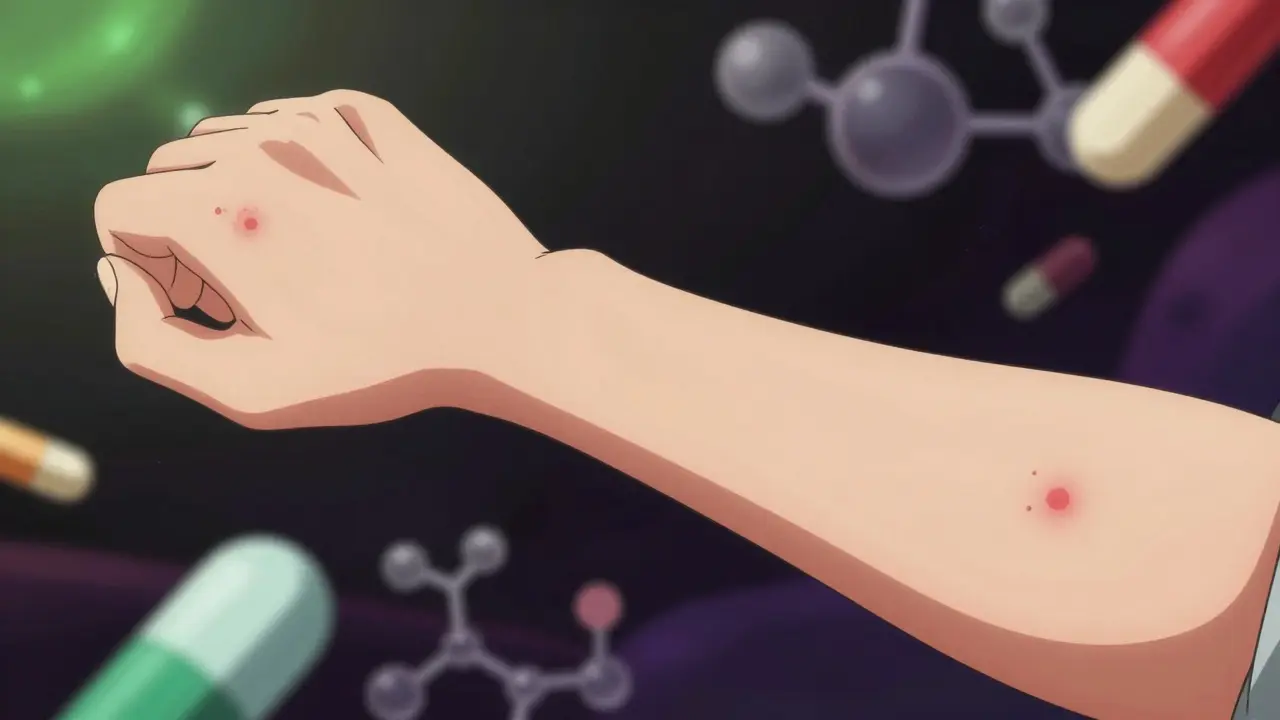
About 60-70% of medication allergies fall into the mild category. These are usually localized, meaning they stay in one area or only cover a small part of your skin. Common signs include a few patches of Urticaria, the medical term for hives, characterized by itchy, raised welts
, or a slight itchiness.In these cases, your histamine levels are usually low (around 2-5 ng/mL), and your blood pressure and breathing remain perfectly normal. Most mild reactions resolve within 24 to 48 hours with a simple over-the-counter antihistamine. While not dangerous, they are crucial markers. If you have a mild reaction now, you need to document exactly which drug caused it to avoid a more severe response in the future.

Moderate Reactions: When it Becomes Systemic
A reaction moves from mild to moderate when it becomes systemic-meaning it affects your whole body rather than just one patch of skin. You might see widespread hives covering 10-30% of your body or experience Angioedema, deep swelling of the skin, often around the eyes, lips, or extremities
.You might also run a moderate fever (between 38.5°C and 39.5°C). While you aren't in immediate respiratory distress, this is a "warning zone." Moderate reactions often require corticosteroids to bring the inflammation down and a few hours of observation in a clinic to ensure the symptoms don't escalate into something worse.
| Feature | Mild | Moderate | Severe |
|---|---|---|---|
| Body Surface Area | < 10% | 10% - 30% | > 30% or systemic |
| Vital Signs | Stable | Stable / Slight Fever | Unstable (BP < 90 mmHg) |
| Key Symptom | Localized Itch | Widespread Hives | Airway Closure / Skin Peeling |
| Typical Treatment | Antihistamines | Corticosteroids | Epinephrine / ICU Care |
Severe Reactions: The Critical Emergencies
Severe reactions affect 5-10% of allergic patients, but they carry the highest risk of death. These are the cases where the immune system goes into overdrive, causing systemic failure. There are three primary "nightmare scenarios" to recognize:
- Anaphylaxis: This is a rapid-onset Type I reaction. Your blood pressure drops (systolic BP below 90 mmHg), your oxygen levels plummet (SpO2 below 90%), and your throat may close. This requires an immediate dose of epinephrine to reverse the shock.
- SJS and TEN: Stevens-Johnson Syndrome (SJS) is a severe skin reaction where the epidermis separates from the dermis, causing blisters and peeling . If more than 30% of the skin detaches, it becomes Toxic Epidermal Necrolysis (TEN). These patients often need treatment in specialized burn units because their skin can no longer protect them from infection.
- DRESS Syndrome: This is a complex reaction involving a fever, a widespread rash, and organ inflammation (like the liver or kidneys), often accompanied by a high count of eosinophils in the blood.
Certain drugs carry higher risks for these extremes. For example, the drug carbamazepine has a significantly higher risk of causing SJS in people with a specific genetic marker called HLA-B*15:02. This is why genetic screening is becoming more common before prescribing high-risk medications.
Spotting the Red Flags: How to Tell the Difference
The biggest differentiator between a moderate and a severe reaction is vital sign compromise. If you are breathing normally and your heart rate is steady, you are likely in the mild-to-moderate range. The moment you feel a "tightness" in your chest, a swollen tongue, or a feeling of sudden dizziness, you have crossed into severe territory.
Another tricky area is the "slow burn." Some people assume a rash is just a mild side effect. However, if a rash is accompanied by blisters, peeling skin, or a high fever, it could be the start of SJS. In some documented cases, patients were told to "keep taking the drug" for a minor rash, only to end up in the ICU days later when the rash progressed to full skin detachment.
Next Steps and Management
If you suspect you've had a reaction, the path forward depends on where you fall on the severity scale:
For Mild Reactions
Stop taking the medication immediately. Use a topical cream or oral antihistamine to manage the itch. Contact your doctor to report the reaction so it can be added to your permanent medical record. Do not simply "push through it," as the second exposure to the same drug can be more severe than the first.
For Moderate Reactions
Seek medical attention at an urgent care center or emergency room. You will likely need prescription-strength corticosteroids to stop the systemic inflammation. Stay under observation for at least 4-6 hours to ensure the reaction doesn't escalate into anaphylaxis.
For Severe Reactions
This is a 911 emergency. If you have an epinephrine auto-injector (EpiPen), use it immediately in the outer thigh. Get to the nearest emergency department. If skin peeling is involved, you will likely need a transfer to a burn unit or a specialist dermatology ward for intensive fluid management and infection control.
Is every drug rash a true allergy?
No. Not every rash is an immunologically mediated allergy. Many are "non-allergic adverse reactions" or side effects. For example, some people experience "Red Man Syndrome" with vancomycin, which is a pseudoallergy caused by the direct release of histamine rather than an IgE-mediated immune response. True allergies are only about 10-15% of all adverse drug reactions.
Why do some reactions take days to appear?
This is due to the different mechanisms of the immune system. Type I reactions use IgE antibodies and happen almost instantly. Type IV reactions, however, are mediated by T-cells. These cells take longer to recognize the drug and mount an attack, which is why you might see a rash develop 48 to 72 hours after your first dose.
Can a mild reaction become severe later?
Yes. While many mild reactions stay mild, some severe conditions like SJS or DRESS syndrome start as a simple maculopapular rash. If the medication is continued despite these early signs, the reaction can progress to extensive skin detachment or organ failure. This is why any new rash during medication should be evaluated by a professional.
How can I prove I'm allergic to a drug if I can't take it?
Doctors use different tests based on the reaction type. For immediate reactions, they use skin prick tests or in vitro IgE blood tests. For delayed reactions, they may use a Lymphocyte Transformation Test (LTT). In some cases, a "drug challenge" is performed, where a tiny amount of the drug is given under strict medical supervision to see if a reaction occurs.
What is the most common drug to cause severe reactions?
Penicillins are among the most common triggers for anaphylaxis, appearing in about 1 to 5 per 10,000 courses. Sulfonamides and certain anticonvulsants (like carbamazepine) are more frequently associated with severe cutaneous reactions like SJS/TEN, particularly in people with specific genetic markers.