

Supply Chain Economics: How Efficiency Drives Generic Drug Distribution
 Mar, 15 2026
When you pick up a generic pill at the pharmacy, you probably don’t think about the journey it took to get there. But behind that simple box is a high-stakes game of cost, timing, and risk - one where even a tiny inefficiency can mean the difference between a patient getting their medicine or going without. In the world of generic drugs, where profit margins are razor-thin and demand is unpredictable, efficiency isn’t just nice to have - it’s survival.
Why Generic Drugs Are Different
Generic drugs aren’t just cheaper versions of brand-name pills. They’re commodities. And commodities are traded on price, not loyalty. A single generic medication can have dozens of manufacturers competing to sell it for pennies. That sounds great for consumers - until it doesn’t. When margins shrink, companies cut corners. They reduce backup suppliers. They eliminate safety stock. They rely on one factory, one shipping route, one country for the active ingredient. That’s the paradox: the cheaper the drug, the riskier its supply chain. According to Drug Patent Watch’s 2023 analysis, generics priced below $0.10 per pill have a 73% higher chance of running out than those costing more. Why? Because no one wants to spend money on redundancy when the profit is barely above zero.The Numbers That Matter
Efficiency in generic distribution isn’t about feeling good - it’s about hard metrics. Top performers track three things relentlessly:- Overall Equipment Effectiveness (OEE): This measures how well a manufacturing line runs. Top distributors hit 85% or higher. The industry average? Just 68-72%. A 10-point gap here means more pills made, less waste, fewer delays.
- Perfect Order Percentage: It’s not enough to deliver on time. The order must be complete, undamaged, and properly documented. Leaders hit 95%+ on this. Lagging distributors? Often below 80%.
- Inventory Turnover: How many times a year does your inventory cycle? The industry average is 8.3 times per year. The best? Over 12.7 times. That’s not luck - it’s precision.
How Efficiency Is Built - Not Bought
You can’t buy efficiency. You build it. And it starts with data. Most generic distributors still use old-school forecasting: “Last month we sold 10,000 bottles. We’ll order 10,000 again.” That’s like driving blindfolded. Leading companies now use AI-powered tools that analyze not just past sales, but hospital usage patterns, insurance claims, even weather trends that affect chronic disease flare-ups. These systems cut forecast errors by 25-40%. That means fewer overstocks and fewer shortages. Then there’s inventory. The Economic Order Quantity (EOQ) formula - Q = √(2KD/G) - isn’t just math. It’s a lifeline. It balances the cost of ordering more stock against the cost of storing it. Companies using this method cut stockouts by 30-45%. That’s not theory. It’s what Teva achieved after overhauling its system in 2022. And don’t forget temperature. Nearly half of all generic drugs need climate-controlled shipping. IoT sensors on pallets now track real-time heat, humidity, and shock. If a shipment goes outside range, the system flags it before it reaches a pharmacy. That’s how you avoid a $500,000 loss - and a patient going without.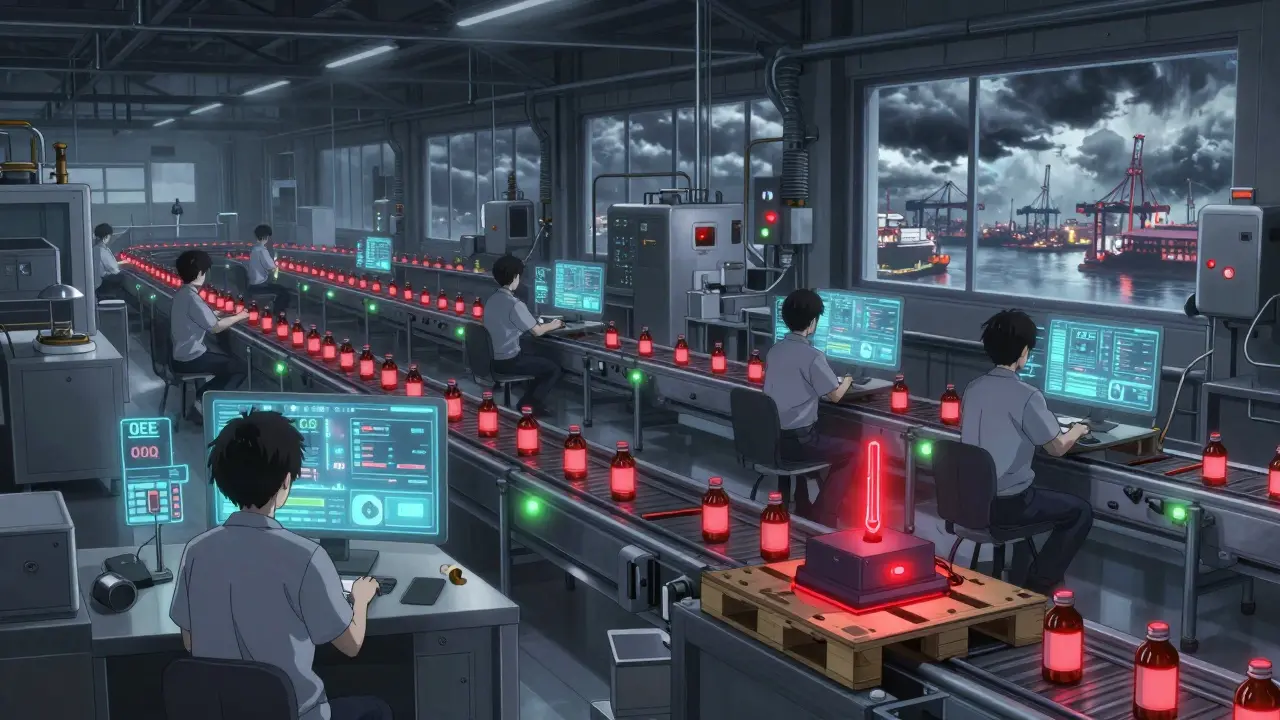
The Two Models: Just-in-Time vs. Just-in-Case
There are two ways to run a generic drug supply chain:- Just-in-Time (JIT): Order only what you need, when you need it. Saves 22-35% on storage costs. But raises stockout risk by 15-20% during disruptions. Many companies tried this - then watched their shelves go empty during the 2021 API shortage.
- Just-in-Case (JIC): Keep extra on hand. Slows inventory turnover. Increases holding costs by 18-28%. But cuts stockouts by 40-60%. The smartest operators use a hybrid: JIT for most drugs, JIC for critical ones.
Technology Is the Great Divider
Here’s the truth: the biggest gap between winners and losers isn’t experience, or size, or history. It’s technology. The top 10 generic distributors now use cloud-based ERP systems that give real-time visibility across every warehouse, truck, and factory. They connect with suppliers via APIs. They use AI to reroute shipments when storms hit. They predict demand down to the zip code. Cardinal Health invested $150 million in predictive analytics in 2021. By 2022, their market share grew by 3.2%. Meanwhile, smaller distributors still rely on spreadsheets and phone calls. Their systems can’t talk to each other. Their data is siloed. Their response time? Days. Not hours. And it’s getting worse. The FDA’s Drug Supply Chain Security Act (DSCSA) now requires full electronic traceability. Every bottle, every box, every pallet must be tracked from factory to pharmacy. That adds 5-8% to operational costs. Smaller players can’t absorb that. They’re being pushed out.Who’s Winning - And Who’s Falling Behind
The market is split into three tiers:- Leaders (McKesson, Cardinal Health, AmerisourceBergen): Control 85% of U.S. distribution. They spend millions on tech. They hit 9.2% EBITA margins. They’re growing.
- Mid-tier: Have some tech, but not integrated. Margins hover around 7-8%. They’re surviving, but not thriving.
- Strugglers: Still using legacy systems. Margins below 6.5%. They’re losing 3-5% market share every year.

The Human Cost of Inefficiency
This isn’t abstract. When a generic drug runs out, people suffer. A 2022 Harvard Business Review piece by former AmerisourceBergen COO John Smith pointed out that 65% of essential generics are now made by just one or two factories. One fire. One earthquake. One regulatory shutdown - and a whole class of patients is left without treatment. In 2023, a shortage of a common blood pressure medication hit rural clinics in Texas. Patients were switched to more expensive alternatives. Some went without. The cost? Not just dollars - lives.What Needs to Change
The system is broken, but fixable. Here’s what needs to happen:- Build redundancy: Don’t rely on one country for active ingredients. Diversify sourcing - even if it costs a little more.
- Invest in AI forecasting: Stop guessing. Start predicting.
- Keep buffer stock for critical drugs: Insulin, epinephrine, antivirals - these aren’t commodities. They’re lifelines.
- Break down approval chains: One distributor manager told Reddit, “We had six people sign off on a single supplier change. By the time we approved it, the shortage was already here.” Speed matters.
What’s Next
By 2027, the best generic distributors will run digital twins of their entire supply chains - virtual replicas that simulate every possible disruption before it happens. They’ll forecast with 95%+ accuracy. They’ll cut inventory costs by half. They’ll deliver 99%+ of orders perfectly. The question isn’t whether this will happen. It’s whether your distributor is ready.If you’re a patient, ask: “Is my generic drug from a supplier with backup plans?” If you’re a provider, demand better systems. If you’re in the industry - start building now. Because the next shortage won’t wait.
Why are generic drug shortages so common?
Generic drug shortages happen because manufacturers cut costs to survive in a low-margin market. Many rely on a single factory or country for the active ingredient, with no backup. When that one source fails - due to natural disaster, regulatory action, or equipment breakdown - supply vanishes. The 2023 Drug Patent Watch report found that 73% more shortages occur in the cheapest generics because they have the least redundancy.
How do companies calculate the right amount of inventory to keep?
Leading distributors use the Economic Order Quantity (EOQ) formula: Q = √(2KD/G), where K is ordering cost, D is demand, and G is carrying cost per unit. This balances the cost of ordering new stock against the cost of storing it. Companies using this method reduce stockouts by 30-45%. Many also combine EOQ with AI forecasting to adjust for real-time demand shifts, not just historical trends.
Is just-in-time inventory a good strategy for generics?
Just-in-time (JIT) reduces storage costs by 22-35%, but increases stockout risk by 15-20%. It works for stable, high-volume drugs - but not for critical medications. The safest approach is hybrid: use JIT for non-essential drugs, and keep 15-20% buffer stock for lifesaving generics like insulin, epinephrine, or antibiotics. A 2023 survey found 68% of distributors who eliminated all safety stock faced severe shortages.
What role does technology play in fixing supply chain inefficiencies?
Technology is the biggest differentiator. Cloud-based ERP systems give real-time visibility. IoT sensors monitor temperature during shipping. AI forecasts demand 25-40% more accurately than traditional methods. Companies like Cardinal Health and McKesson now use AI platforms that cut forecast errors by over 30%. Without this tech, distributors can’t compete - and patients pay the price.
Why are small distributors falling behind?
Small distributors can’t afford the $2-4 million needed to upgrade legacy systems or implement blockchain traceability. They also lack the scale to justify investments in AI forecasting or IoT monitoring. While top players now track every shipment electronically, many small firms still rely on phone calls and spreadsheets. As regulations tighten and competition grows, these firms are being squeezed out - leading to further consolidation in the industry.
Manish Singh
March 15, 2026 AT 15:37Man, I’ve seen this play out in rural India-where a single factory shutdown in China can leave entire villages without blood pressure meds. It’s not just about profit margins; it’s about people dying because someone thought ‘efficiency’ meant running on fumes. The hybrid model? That’s the only sane approach. Keep JIT for aspirin, JIC for insulin. Simple.
Amadi Kenneth
March 17, 2026 AT 01:47Wait… so you’re telling me the government isn’t secretly controlling the API supply chain to push people toward expensive brand drugs?? That’s the only explanation for why every shortage hits right after a patent expires. I’ve got contacts in Bangladesh-there’s a whole underground network rerouting raw materials through Cambodia. They’re not ‘inefficient’-they’re being erased.
Shameer Ahammad
March 18, 2026 AT 12:33It is a matter of profound moral failure that we allow commodification of life-saving pharmaceuticals to be governed by economic models designed for widgets. The EOQ formula, while mathematically elegant, ignores the human cost of stockouts. One must ask: Is it ethical to optimize for inventory turnover when that turnover translates into a diabetic going without insulin? The answer is no. And yet, here we are.
Laura Gabel
March 18, 2026 AT 21:18Ugh. Another post about how rich companies are too lazy to stockpile medicine. Look, if you can’t afford to keep a 15% buffer, maybe you shouldn’t be in the business of distributing pills that keep people alive. This isn’t a supply chain problem-it’s a greed problem. And we’re all paying for it.
Melissa Starks
March 20, 2026 AT 00:16I work in a clinic in Ohio. We had a 3-month shortage of metformin last year. Patients started showing up with HbA1c levels over 12. One woman lost her foot. We switched them to a brand-name version-cost $220 a month. Insurance denied it. So she stopped taking it. I’ve seen this too many times. This isn’t economics. This is neglect dressed up as efficiency. And the worst part? We knew it was coming. We told them. No one listened.
Nilesh Khedekar
March 21, 2026 AT 18:36lol so u think AI is gonna save us? bruh. the same companies that use ‘predictive analytics’ are the ones who lobbied to shut down 3 indian API plants in 2020. they want monopoly. they want u dependent. they want u to pay $10 for insulin when it costs 2 cents to make. this whole ‘efficiency’ thing? its a scam. they just want to kill competition. and then raise prices. mark my words.
Alexander Pitt
March 23, 2026 AT 09:01The 85% OEE benchmark isn’t arbitrary-it’s the point where waste drops below 15%, and that’s the threshold where you can afford to reinvest in redundancy. Top performers don’t just use AI; they integrate it with supplier risk scoring, real-time logistics tracking, and automated safety stock triggers. It’s not magic. It’s engineering. And yes, it’s expensive-but so is a patient dying because you saved $0.02 per pill.
Kal Lambert
March 23, 2026 AT 20:48Buffer stock for critical drugs isn’t optional. It’s basic risk management. You don’t skip fire insurance because your house has never burned down. Same logic. The math is clear. The ethics are clearer.
Melissa Stansbury
March 24, 2026 AT 07:43My dad’s on warfarin. He’s been on it for 12 years. Last year, his pharmacy ran out. They said ‘it’ll be back in a week.’ It took 4 months. He had a stroke. They said ‘it was an isolated incident.’ But it wasn’t. It was systemic. And now I’m asking: who’s accountable? Not the pharmacist. Not the doctor. Someone in a boardroom decided it wasn’t worth the cost. Someone made that call. And now my dad walks with a cane.
cara s
March 26, 2026 AT 05:56While I appreciate the technical depth of this analysis, I must respectfully note that the implicit assumption-that market forces alone can be trusted to manage pharmaceutical supply chains-is dangerously naive. The DSCSA mandate, while burdensome, is a necessary corrective. To equate efficiency with profit maximization is to misunderstand the fundamental nature of healthcare as a public good, not a commodity. The fact that we are even debating whether to maintain buffer stock for insulin reveals a profound moral crisis in our economic paradigm.
Robin Hall
March 27, 2026 AT 15:41Who owns the cloud-based ERP systems? Who owns the AI algorithms? Who owns the IoT sensors? The same five private equity firms that own 70% of U.S. hospitals. This isn’t about efficiency. It’s about consolidation. They want one supplier. One system. One database. One choke point. And when that fails? They’ll blame the ‘unpredictable market.’ But it was planned. It always is.
Suchi G.
March 28, 2026 AT 08:16I just want to say… I cried reading this. Not because I’m emotional (though I am) but because I’ve been the one holding a 500ml vial of epinephrine in a hospital at 3am while a kid’s oxygen saturation dropped. We had no backup. The distributor said ‘it’s on backorder.’ I looked at the mother. She didn’t cry. She just whispered, ‘Is he gonna die?’ I didn’t answer. I couldn’t. This isn’t a supply chain issue. It’s a soul-crushing, daily horror. And no one in corporate cares. They just want the next quarterly report.
Andrew Muchmore
March 30, 2026 AT 08:29Redundancy isn’t waste. It’s insurance. And if you’re not willing to pay the premium on a lifesaving drug, you shouldn’t be in the business. Simple as that. Stop pretending this is about economics. It’s about who gets to live and who gets to die.
Paul Ratliff
March 31, 2026 AT 14:02Just had a patient ask me if I could get her metformin. Said she’s been skipping doses for 3 months. Said she’s scared. I said I’ll try. I didn’t tell her I’ve called 7 distributors. All said ‘out of stock.’ She’s 72. Doesn’t have a car. Lives alone. This isn’t a spreadsheet. This is real life. And we’re failing.