

Thyroid Medications in Pregnancy: Dose Adjustments and Monitoring
 Mar, 20 2026
When a woman becomes pregnant and has hypothyroidism, her body’s demand for thyroid hormone jumps almost immediately. Many don’t realize this until it’s too late. That’s why levothyroxine dosing isn’t something you can ignore or delay. Skipping a dose adjustment-even for a few weeks-can affect your baby’s brain development. The good news? With the right plan, you can keep both you and your baby healthy.
Why Thyroid Hormone Matters in Pregnancy
Your baby’s brain starts developing from day one. For the first 10 to 12 weeks, it relies entirely on your thyroid hormone. If your levels are too low, your baby doesn’t get enough. Studies show that untreated or poorly managed hypothyroidism during pregnancy increases the risk of miscarriage, preterm birth, and lower IQ scores in children. In fact, research from the Endocrine Society found that properly managed thyroid disease can improve child IQ by 7 to 10 points. That’s not a small difference-it’s life-changing.Levothyroxine (LT4) is the only medication recommended for hypothyroidism in pregnancy. Brands like Synthroid® are widely used in the U.S., but generic versions work just as well if they’re consistent. The goal? Keep your TSH (thyroid-stimulating hormone) within trimester-specific ranges. Too high, and you risk developmental delays. Too low, and you might be overtreated, which carries its own risks.
How Much More Medication Do You Need?
Most women with pre-existing hypothyroidism need to increase their levothyroxine dose as soon as they find out they’re pregnant. The increase isn’t small-it’s usually 20% to 30%. Some guidelines, like those from the American Thyroid Association (ATA), suggest taking two extra doses per week. Others, like ACOG, recommend an immediate 50 mcg boost right after confirmation.Here’s what the data shows:
- One NIH study of 280 women found their average dose went from 85.7 mcg before pregnancy to 100.0 mcg in the first trimester-a 16.7% increase.
- Women with TSH over 10 mIU/L at diagnosis are often started at 1.6 mcg per kg of body weight per day.
- For mild cases (TSH 5-10 mIU/L), a 25-50 mcg increase is typical.
- Severe cases (TSH over 20 mIU/L) may need 75-100 mcg more per day.
There’s no one-size-fits-all answer. But the pattern is clear: if you had hypothyroidism before pregnancy, you almost certainly need more medication. And you need it now-not next month.
When to Adjust Your Dose
Don’t wait for your first prenatal visit. Thyroid hormone demand spikes within days of conception. By the time you miss your period, your body is already asking for more. Experts agree: increase your dose as soon as you get a positive pregnancy test.Many patients delay because their OB-GYN doesn’t bring it up. A 2019 survey of 150 OB-GYNs found that 68% didn’t check TSH at the first prenatal visit for women with known thyroid disease. That’s a gap in care. You shouldn’t have to advocate for yourself-but if you do, here’s what to say: “I have hypothyroidism. According to the American Thyroid Association, I need my dose increased immediately after pregnancy confirmation.”
Some women try to make up for the increase by taking extra pills on weekends. But that can cause fluctuations. A better approach? Spread the extra dose across the week. If you normally take 100 mcg daily, switch to 115 mcg daily instead of 100 mcg five days and 130 mcg two days. This keeps your levels stable.
How Often Should You Get Tested?
Testing every 4 weeks is the standard. But timing matters. The ATA recommends checking TSH within 4 weeks of any dose change and again every 4 weeks until levels stabilize. After that, you can space out checks to every 6-8 weeks.Here’s a practical schedule based on expert guidelines:
- Test TSH at 4-6 weeks gestation (as soon as possible after confirmation)
- Test again at 8-10 weeks
- Test again at 16-20 weeks
- Test again at 24-28 weeks
- Test one last time at 32-34 weeks
Why so many checks? Because your needs keep changing. In the second trimester, your body produces more thyroid-binding proteins, which lowers free hormone levels. By the third trimester, your dose may need another tweak. Don’t assume your first adjustment is enough.
What Should Your TSH Target Be?
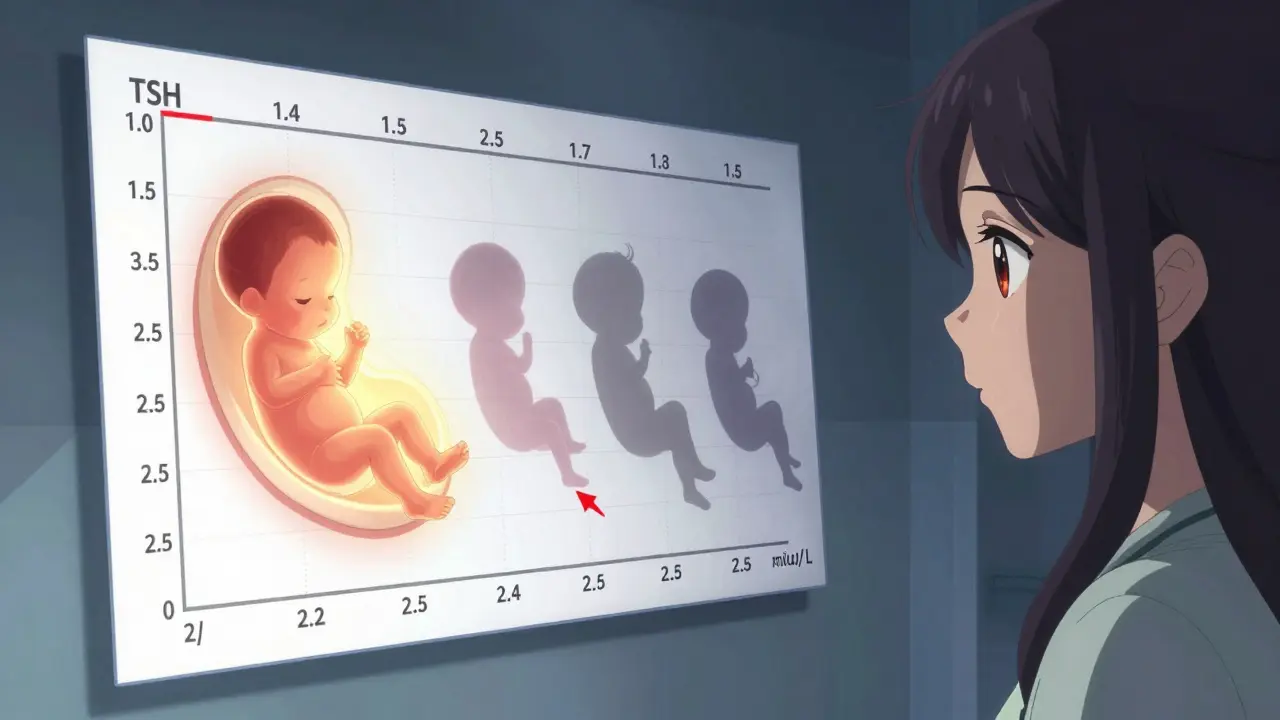
There’s some debate here. The ATA recommends keeping TSH below 2.5 mIU/L throughout pregnancy. The Endocrine Society says it’s okay to go up to 3.0 mIU/L in the second and third trimesters. But most experts agree: the first trimester is the most critical.Here’s what the numbers say:
- Women with TSH above 2.5 mIU/L in the first trimester have a 69% higher risk of miscarriage.
- Studies show that keeping TSH below 2.5 improves neurodevelopmental outcomes.
- If you have thyroid antibodies (TPO), most guidelines recommend even stricter control-targeting TSH under 2.5 the whole time.
Don’t get hung up on the exact number. Focus on the trend. If your TSH is creeping up, adjust early. Waiting until it hits 4.0 is too late.
How to Take Your Medication Right
Taking levothyroxine wrong can make all your efforts useless. Here’s what actually works:- Take it on an empty stomach-first thing in the morning, 30 to 60 minutes before eating.
- Avoid calcium, iron, or prenatal vitamins within 4 hours. These bind to levothyroxine and block absorption by up to 50%.
- If you take your prenatal vitamin at night, that’s fine. Just keep it separate from your thyroid pill.
- Don’t switch brands without checking with your doctor. Even generic versions can vary slightly in absorption.
One patient on Reddit said she took her pill with coffee and wondered why her TSH stayed high. Coffee can interfere too. Stick to water. Keep it simple.
What About Breastfeeding?
Good news: levothyroxine is safe during breastfeeding. Only tiny amounts pass into breast milk, and studies show no effect on infant thyroid function. In fact, maintaining your own thyroid levels helps your milk supply and your energy. You can continue your pregnancy dose without changes after delivery.Just don’t stop or lower your dose just because you’re no longer pregnant. Your body may need time to adjust back. Check your TSH 6-8 weeks postpartum. Some women need to go back to their pre-pregnancy dose. Others need to stay higher. Only a blood test will tell.

Real Challenges in Real Life
Guidelines are clear. But real life? Not always.One woman shared on a patient forum: “My doctor waited until my 12-week visit to check my TSH. By then, my level was 4.2. I panicked for weeks.” Another said, “I had to push for a dose increase. My OB said, ‘Just wait and see.’”
These aren’t rare stories. A 2021 study showed that women who got their dose adjusted within 4 weeks of pregnancy confirmation had 23% fewer preterm births. Delayed care has real consequences.
On the flip side, women who followed the plan closely had better outcomes. One mom reported her daughter scored in the 90th percentile for development at 18 months. She credited her endocrinologist’s immediate dose increase.
What’s New in 2026?
Things are moving fast. In 2023, the ATA started recommending universal TSH screening for all pregnant women-not just those with known thyroid disease. That’s a big shift. It means more women might get diagnosed early.AI tools are now being tested to predict your ideal dose based on your pre-pregnancy TSH, weight, and antibody status. One 2022 trial showed these tools improved control by 28% compared to standard dosing. By 2026, more clinics are using electronic health records (like Epic) that automatically flag pregnant patients on levothyroxine and suggest dose increases.
And globally? The WHO added levothyroxine to its Essential Medicines List for maternal health. In low-income countries, only 22% have consistent access. That’s why education and access matter just as much as dosing.
What You Should Do Now
If you’re pregnant and on levothyroxine:- Call your endocrinologist or doctor the day you get a positive pregnancy test.
- Ask for your dose to be increased by 20-30% immediately.
- Get your TSH tested within 4 weeks.
- Take your pill on an empty stomach with water, at least 30 minutes before food.
- Keep calcium and iron supplements at least 4 hours apart.
- Keep checking TSH every 4-6 weeks until delivery.
If you’re not on medication but have symptoms like fatigue, weight gain, or cold intolerance-get tested. Hypothyroidism can develop during pregnancy. And yes, it’s treatable.
Final Thought
Thyroid medication in pregnancy isn’t complicated. It’s not magic. It’s science-simple, precise, and life-saving. You don’t need to be an expert. You just need to be informed. And if your provider doesn’t know the guidelines? Share them. Your baby’s brain depends on it.Do I need to increase my levothyroxine dose as soon as I find out I’m pregnant?
Yes. Thyroid hormone demand rises immediately after conception. Most women need a 20% to 30% increase in levothyroxine right away. Waiting until your first prenatal visit can put your baby at risk. The American Thyroid Association recommends increasing your dose the day you get a positive pregnancy test.
What’s the ideal TSH level during pregnancy?
The American Thyroid Association recommends keeping TSH below 2.5 mIU/L throughout pregnancy. The Endocrine Society allows up to 3.0 mIU/L in the second and third trimesters, but most experts agree that staying under 2.5 is safest-especially in the first trimester. If you have thyroid antibodies (TPO), aim for under 2.5 the whole time.
Can I take levothyroxine with my prenatal vitamin?
No. Calcium and iron in prenatal vitamins block levothyroxine absorption by up to 50%. Take your thyroid pill on an empty stomach with water, at least 30-60 minutes before eating. Take your prenatal vitamin at night, or at least 4 hours after your thyroid pill.
Is it safe to breastfeed while taking levothyroxine?
Yes. Only tiny amounts of levothyroxine pass into breast milk, and studies show no effect on the baby’s thyroid function. Continue your pregnancy dose after delivery. Your doctor may adjust it later, but don’t stop without testing your TSH first.
How often should I get my TSH checked during pregnancy?
Check TSH every 4 weeks after any dose change, and at least once per trimester. A practical schedule: test at 4-6 weeks, 8-10 weeks, 16-20 weeks, 24-28 weeks, and 32-34 weeks. Don’t assume your first adjustment is enough-your needs keep changing.
What if my doctor doesn’t know about thyroid changes in pregnancy?
Many OB-GYNs aren’t trained in thyroid management. If your provider hesitates, say: “According to the American Thyroid Association guidelines, I need my dose increased immediately after pregnancy confirmation, and TSH should be checked every 4 weeks.” You can also ask for a referral to an endocrinologist. Your baby’s brain development depends on timely care.
Can I switch from brand-name Synthroid to generic levothyroxine during pregnancy?
You can, but only under your doctor’s supervision. Even small differences in absorption between brands can affect your TSH. If you switch, get your TSH checked 6 weeks later. Consistency matters more than cost. If your dose was stable on Synthroid, staying on it may be the safest choice.
Bryan Woody
March 22, 2026 AT 00:18Timothy Olcott
March 22, 2026 AT 22:56Desiree LaPointe
March 23, 2026 AT 23:43Jackie Tucker
March 25, 2026 AT 06:55Thomas Jensen
March 26, 2026 AT 07:39Chris Dwyer
March 26, 2026 AT 10:40matthew runcie
March 28, 2026 AT 07:24shannon kozee
March 28, 2026 AT 18:56Shaun Wakashige
March 28, 2026 AT 23:34Natali Shevchenko
March 30, 2026 AT 15:23Johny Prayogi
April 1, 2026 AT 00:13Nicole James
April 1, 2026 AT 00:18Nishan Basnet
April 2, 2026 AT 08:27