

Why You Shouldn't Store Medications in the Bathroom
 Jan, 14 2026
Most people keep their medications in the bathroom. It’s convenient-right next to the sink, close to where you brush your teeth, easy to grab before bed or after breakfast. But here’s the hard truth: your bathroom is one of the worst places to store pills, liquids, patches, or inhalers. And it’s not just a myth. It’s science. And it’s putting your health at risk.
Why the Bathroom Is a Medication Killer
Bathrooms are hot, steamy, and wet. That’s fine for your shower, but terrible for your medicine. When you run hot water, the temperature in the room can jump 20-30°F in minutes. Humidity spikes to 80-100%. That’s not just uncomfortable-it’s destructive. Medications are chemical compounds designed to stay stable under controlled conditions. Most need to be kept between 59°F and 77°F (15°C-25°C). Your bathroom? It rarely stays there. A study from Baystate Health found that bathroom cabinets regularly exceed these limits, especially after a shower or bath. The moisture doesn’t just make your mirror fog up-it starts breaking down your drugs. Tablets absorb water. That causes hydrolysis-the chemical breakdown of active ingredients. Capsules get sticky or brittle. Powders clump. Insulin? It turns useless above 86°F. Nitroglycerin, used for heart attacks, loses potency in just days if exposed to humidity. Birth control pills? FDA testing shows their hormone levels can drop by up to 35% when stored in damp environments. And it’s not just about effectiveness. It’s about safety. If your blood pressure medication loses strength, you could have a stroke. If your antibiotic degrades, your infection won’t clear-and that contributes to antibiotic resistance, a global health crisis the WHO calls one of the top threats of our time.What Happens When Medications Go Bad?
You might think, “It’s just a pill. It’ll still do something.” But that’s dangerous thinking. A study published in Circulation found that 30.2% of patients who stored beta-blockers in humid environments had inconsistent blood pressure control. Their meds weren’t working-because they’d degraded. Another study in the Journal of Diabetes Science and Technology showed that blood glucose test strips stored in bathrooms gave wrong readings in 68% of cases. Imagine adjusting your insulin dose based on a false number. Real cases are even more alarming. WELLFOR’s 2023 analysis tracked patients whose warfarin (a blood thinner) degraded in bathroom cabinets. Some developed dangerous clots. Others bled uncontrollably because the dose was off. In London’s Great Ormond Street Hospital, 4.3% of pediatric medication errors in 2022 were traced back to expired or degraded drugs stored in bathrooms. One nurse on Reddit shared that she checked 50 patients’ home meds. In bathrooms, 42% showed visible signs of damage-discolored pills, crumbling tablets, sticky patches. In bedrooms? Only 8%.It’s Not Just About Potency-It’s About Access
The bathroom medicine cabinet isn’t just bad for your drugs. It’s bad for your family. The CDC reports that 70% of misused prescription opioids come from home medicine cabinets. And where are those cabinets? Usually unlocked, in the bathroom-easy for teens, guests, or even curious toddlers to reach. A 2022 NIH study found that 63% of households with children kept high-risk medications within reach. The American Academy of Pediatrics says that’s unacceptable. All medications, especially opioids, stimulants, and sedatives, should be locked away. And pets? They’re curious too. A degraded painkiller or antidepressant left on the counter can be deadly to a dog or cat. Veterinarians see cases every month where pets are poisoned by meds that were supposed to be out of reach.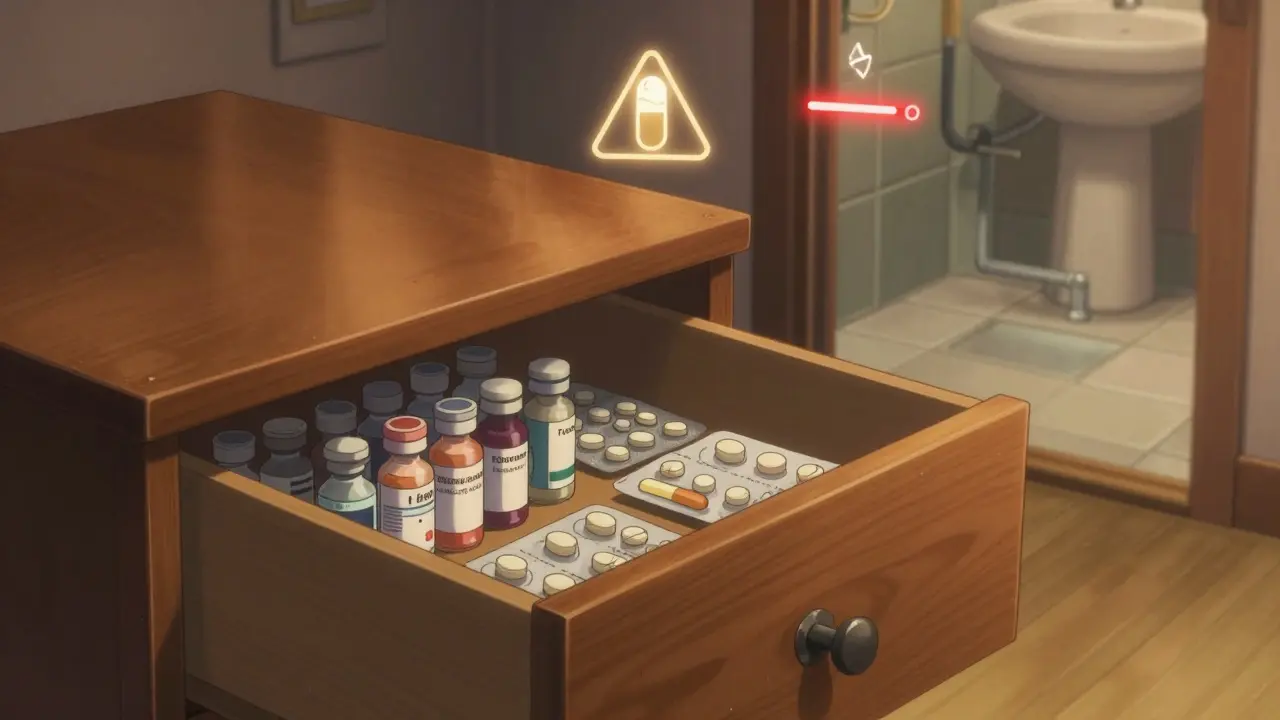
Where Should You Store Your Medications Instead?
The solution is simple: find a cool, dry, and locked place. Best options:- A locked cabinet in your bedroom
- A high drawer in a dresser
- A closet shelf away from windows or heat sources
What About the “Expiration Date”?
Expiration dates aren’t just a suggestion. They’re based on stability testing under ideal conditions. If your medicine was stored in the bathroom for six months, it might be useless before the date even hits. A study from the NIH found that properly stored medications kept 98.7% of their potency after six months. Bathroom-stored ones? Only 72.3%. That’s a 26% drop. For something like an EpiPen or seizure medication, that difference could be life-or-death. Check your pills. If they’ve changed color, smell odd, cracked, or stuck together, toss them. Don’t risk it.
How to Dispose of Old or Damaged Medications
Don’t flush them. Don’t throw them in the trash. Don’t pour them down the sink. The environment pays the price. The EPA says 46% of medications found in waterways come from improper disposal. Fish, frogs, and even drinking water are contaminated. Use a drug take-back program. Many pharmacies, hospitals, and police stations have drop boxes. In Australia, the National Drug Strategy has safe disposal bins at over 1,200 locations. If that’s not available, mix pills with coffee grounds or cat litter, seal them in a plastic bag, and throw them in the trash. Remove personal info from bottles first.What’s Changing? The Future of Safe Storage
More companies are waking up. Since 2020, 73% of prescription bottles now include storage instructions-up from 41% in 2015. Some bottles now come with humidity-indicating strips. If the strip turns red, your meds are exposed to too much moisture. Smart medicine cabinets are starting to appear-ones that monitor temperature and humidity, then send alerts to your phone. The National Association of Boards of Pharmacy is working on certification standards for these products, expected in early 2024. And apps? A 2023 study showed that medication adherence apps with storage reminders increased proper storage habits by 47%. If your phone reminds you to check your meds, it’s helping.Final Check: Is Your Medication Safe?
Here’s your quick checklist:- Are your meds in the bathroom? → Move them.
- Are they in a drawer or cabinet? → Make sure it’s locked.
- Are they near a window, heater, or sink? → Move them again.
- Do any pills look strange? → Throw them out.
- Do you have expired meds? → Take them to a drop-off point.
- Are kids or pets able to reach them? → Lock them up.
Can I store my medications in the kitchen instead of the bathroom?
Only if the kitchen is cool and dry. Avoid storing meds near the stove, oven, dishwasher, or window. Temperature swings from cooking and opening the fridge can damage drugs. A pantry shelf away from heat sources is better than the bathroom-but a bedroom drawer is still the safest choice.
What if I only keep a few pills in the bathroom for convenience?
Even one pill stored in a humid environment can degrade. If you need quick access to something like nitroglycerin or an EpiPen, keep a backup in your bedroom or purse, not the bathroom. Use the bathroom only for temporary access-never for long-term storage.
Do all medications degrade the same way in humidity?
No. Some are more sensitive than others. Insulin, nitroglycerin, birth control pills, antibiotics, and thyroid meds are especially vulnerable. Liquid medications and patches also degrade faster than solid tablets. Always check the label for storage instructions-many now say “store at room temperature away from moisture.” That means: not the bathroom.
How do I know if my medication has gone bad?
Look for changes: pills that are discolored, cracked, sticky, or smell odd. Capsules that are swollen or leaking. Powders that clump together. If you’re unsure, don’t take it. Bring it to your pharmacist-they can tell you if it’s still safe. Better safe than sorry.
Is it okay to store medications in the car during winter?
No. Cars get extremely hot in summer and freezing in winter. Both extremes damage medications. Even a few hours in a parked car can ruin insulin or blood pressure pills. Always keep meds with you in a temperature-stable place-like your coat pocket or a bag inside the house.
Henry Sy
January 15, 2026 AT 11:58Y’all still storing pills in the bathroom like it’s 2003? Bro, my grandma’s insulin sat in her bathroom for years and she had a stroke. Not a metaphor. Actual stroke. The humidity turns your meds into science fair projects gone wrong.
Andrew Freeman
January 15, 2026 AT 22:36tbh i just throw em in the drawer next to my socks
says haze
January 16, 2026 AT 19:58It’s not merely about storage-it’s about the epistemological failure of modern domesticity. We treat pharmaceuticals as disposable commodities, yet we’re shocked when their molecular integrity collapses under the weight of our domestic negligence. The bathroom isn’t just a room-it’s a metaphor for the entropy of care in late-stage capitalism. Your EpiPen doesn’t expire on the label. It expires the moment you prioritize convenience over scientific literacy.
Dylan Livingston
January 17, 2026 AT 19:08Oh wow, so now I’m a murderer because I keep my Advil next to my toothbrush? Let me grab my lawyer and my guilt journal. Meanwhile, the FDA says most meds are fine for months beyond expiration if stored properly-which, by the way, your bathroom isn’t the only place with humidity. Your kitchen, your car, your damn backpack-all of it’s a death trap according to you. Chill. Your meds aren’t sentient. They’re not gonna rise up and haunt you. Unless you’re storing LSD. Then yeah, maybe.
shiv singh
January 19, 2026 AT 02:27YOU PEOPLE ARE KILLING YOURSELVES WITH STUPIDITY. I saw a child die because her mom kept her asthma inhaler in the bathroom. The pill crumbled. The kid turned blue. The hospital said it was 'degraded medication.' Do you think that’s an accident? No. It’s a choice. You choose to ignore science because you’re too lazy to move a box. I hope your next pill doesn’t work. I hope you choke on your own negligence.
Vicky Zhang
January 19, 2026 AT 05:52Okay, I’m not gonna lie-I used to keep everything in the bathroom. But after reading this, I moved my blood pressure meds to a locked drawer in my bedroom. I even bought one of those little lockboxes from Target. I feel like a superhero now. If you’re still reading this and haven’t moved your meds yet… I believe in you. You can do this. One drawer at a time. Your body will thank you.
Robert Way
January 19, 2026 AT 22:40wait so i shouldnt keep my xanax next to the sink? but thats where i take it... what if i forget where i put it? i just put it in the bathroom because i always forget where everything is
Sarah -Jane Vincent
January 19, 2026 AT 23:48Did you know the government already knows about this? That’s why they put those humidity strips on bottles now. But they don’t tell you. They want you to take degraded meds so you’ll need more. It’s a cycle. Big Pharma + your steamy bathroom = profits. That’s why your prescription costs $500. They’re selling you broken pills. And they know you’ll keep them in the bathroom anyway. Wake up.
Alvin Bregman
January 20, 2026 AT 08:51I get what you’re saying but I’ve got three kids and a dog and a husband who thinks the medicine cabinet is a snack drawer. I moved everything to the bedroom but the kids still find it. I’ve got a locked box now but I still catch my 7-year-old holding up my thyroid pill like it’s a gummy bear. I don’t know what to do anymore
Jason Yan
January 21, 2026 AT 04:32It’s funny how we treat our bodies like machines we don’t have to maintain. We change the oil in our cars every 5k miles but we’ll leave a bottle of antibiotics in a steam room for a decade. Your meds aren’t just chemicals-they’re your lifelines. Think of them like your phone battery: if you expose it to heat and moisture, it dies faster. Would you leave your phone in the shower? No. So why treat your health any differently?
Sarah Triphahn
January 22, 2026 AT 00:11And yet, you still didn’t mention the real issue: the cost. If you can’t afford a locked cabinet or a mini-fridge, what are you supposed to do? Your solution is for people with spare cash and a spare room. Most of us live in studios with one drawer. The bathroom is the only dry space we have. Don’t preach. Offer solutions. Or shut up.
Anna Hunger
January 23, 2026 AT 05:12Thank you for this meticulously researched and clinically significant exposition. The empirical evidence presented regarding pharmaceutical degradation under conditions of elevated humidity and thermal fluctuation is both compelling and alarming. I would respectfully suggest that public health campaigns be expanded to include visual infographics demonstrating comparative degradation rates across storage environments, as well as mandatory labeling on all prescription containers indicating the recommended ambient conditions for stability. This is not merely a personal hygiene issue-it is a systemic public health imperative.