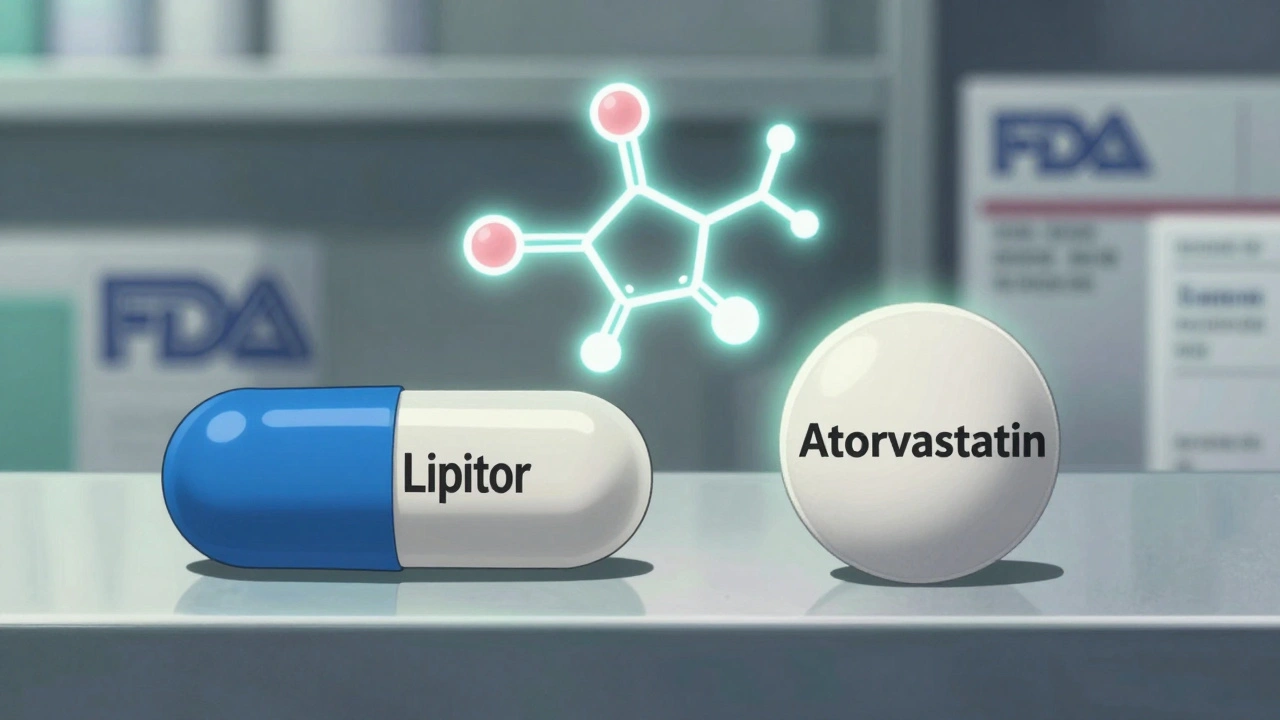
When you hear brand name drugs, medications sold under a proprietary name by the original manufacturer, often protected by patents. Also known as originator drugs, they're the first version of a medicine to hit the market after years of research and clinical trials. These are the pills you see advertised on TV—Drugs like Lipitor, Zithromax, or Prozac. They come with a high price tag, not because they work better, but because the company that made them spent millions developing them and holds exclusive rights to sell them for a set time.
Once that patent expires, other companies can make the same drug under its generic name, the chemical name of the active ingredient, like atorvastatin or azithromycin. Also known as generic equivalents, these versions must meet the same FDA standards for safety, strength, and quality as the brand name. They don’t have fancy packaging or celebrity ads. They’re often 80% cheaper. But here’s the thing: most people don’t realize that 90% of prescriptions filled in the U.S. are for generics. That’s not because doctors are cutting corners—it’s because the science says they work just as well.
Still, brand name drugs aren’t always unnecessary. Sometimes, a brand version has a special delivery system—like a slow-release capsule—that generics can’t perfectly copy. Or maybe you had a bad reaction to a generic version made by a different manufacturer, and your doctor wants to stick with what you know works. That’s valid. But too often, people assume brand name means better, when really, it just means more expensive. The difference in effectiveness between a brand and its generic is usually zero.
And it’s not just about cost. pharmaceutical patents, legal protections that give companies exclusive rights to sell a drug for 20 years, often extended through minor tweaks keep prices high long after the original innovation. Some companies tweak a drug’s shape or coating just to reset the patent clock—this is called evergreening. It doesn’t make the drug better, but it keeps generics off the market. That’s why you’ll see the same drug priced at $150 one month and $15 the next, once the patent drops.
What you need to know is this: your doctor doesn’t automatically pick brand name drugs because they’re superior. They might pick them because they’re familiar, or because they were given samples. But you have a right to ask for the generic. Most insurance plans push you toward generics anyway—they’re cheaper for them, too. And if you’re on a tight budget, going generic isn’t a compromise—it’s a smart choice backed by decades of real-world use.
There’s also the issue of drug pricing, how much you pay for a medication, which can vary wildly based on country, insurance, and pharmacy. In the U.S., you might pay $500 for a brand name drug. In Canada or Europe, the same pill could cost $30. Why? Because other countries negotiate prices directly with manufacturers. Here, it’s a free-for-all. That’s why people travel for meds or buy online—because the system doesn’t make sense.
Below, you’ll find real stories and facts about how these drugs behave in your body, how insurance tiers affect what you pay, why some generics are hard to find, and how food, genetics, and even your liver can change how well any drug—brand or generic—works for you. You’re not just buying a pill. You’re buying a system. And knowing how it works can save you money, time, and even risk.
Generic drugs work the same as brand-name drugs but cost far less. Learn how the FDA ensures therapeutic equivalence, why labels look different, and when you should be cautious about switching.